

Text by Liu Hsing-Yu
Translated by Chuang Chi-Wei
Foreword
‘What is contemporary painting?’ is a grand, time-transcending query. A question far more attuned to our present reality, however, is: In what kind of visual environment and art education system are Taiwanese painters nurtured today? And through what institutions and mechanisms do they enter the public sphere to become ‘artists’ in common ‘understanding?’
Furthermore, as an independent discipline and methodology, art history seems to be constantly accelerating in the ‘contemporary’ context. Often, just when we can barely identify and name a period, it is swiftly thrown even further behind. I have frequently experienced this feeling while visiting museums in Europe and the United States. Since speed is always a matter of relative perception, while I was still lingering in the Pre-Impressionist and Post-Impressionist galleries an hour prior—beginning my viewing with my preferred Nabis, Symbolism, and Surrealism—as I approached the latter part of the exhibition, the rooms requiring switching began to multiply, and the tempo grew urgent and fast, as if art history were suddenly compressed and accelerated within just a few exhibition galleries.
Undoubtedly, the transmutation of medium, form, and image culture has ensured that the trajectory of painting over the past half-century—following Abstract Expressionism is no longer a mere succession of single ‘-isms,’ but has gradually unfolded into parallel visual experiments along multiple paths. The notion that ‘painting is dead’ has recurred repeatedly, to the point of being somewhat perplexing: Was it a reincarnation, or yet another proclamation of death? Meanwhile, painting continues to intersect with various image cultures—Pop Art, Photorealism, and beyond. Painting has progressively become an experimental platform for artists to recombine image experiences and visual languages.
Even when such narratives appear beyond doubt, we can still learn from artists to ask self-reflexive questions: 'Do creators residing in Taiwan truly lack other long-interwoven visual systems?' Within the geopolitical dynamics of East Asia, the tradition of ink painting and calligraphy has exercised a profound influence; even within subcultural image systems that began entering artistic discourse in the early twenty-first century, a subtle yet profound connection to the calligraphic and ink traditions quietly persists.
Today, with the further intervention of digital technologies and audio-visual media, the generation and re-organization of imagery have grown increasingly complex. Yet, looking back at Taiwanese art history, such multiple visual systems become even more distinctly visible. Consequently, the artistic nurturing of Taiwanese painters rarely follows a singular art-historical trajectory; rather, it cultivates a hybrid mode of seeing forged at the intersections of diverse visual cultures.
Opening with these reflections, this essay seeks to articulate the institutional role and viewing framework of the CTBC Painting Prize today, serving as a portal through which to observe the contemporary painting ecosystem. When we revisit and interrogate painting today, we are in fact inquiring into an image-generation system—how it is developed, operated, and produced within an existing environment. This prize also plays a pivotal node between the two: it functions both as an institutional screening mechanism and as a public platform that shapes viewing and discourse. Through such a node, we are able to re-examine the manifold possibilities of contemporary painting within a domain where different generations, spatiotemporal contexts, and visual systems intersect—while simultaneously witnessing how an art ecology gradually outlines its contours amid constant flux.
If that playful subheading were changed to 'Ça suffit!', wouldn't it instantly acquire a touch of fashion and elegance, perhaps even a stance that takes in all living beings at a glance? Or, if sung as 'Usseewa (うっせぇわ)', wouldn't it unleash a touch of rebellion, and an emotional outcry following social suppression? Such fine-grained nuances of tone mirror the Taiwanese art scene itself—at once direct and impossible to disguise. Is not the relationship between a subheading and a painting prize precisely a mirrored one? It is about the courage to face things head-on!
Imposing no restrictions on theme, medium, or size, the CTBC Painting Prize now enters its third edition, shortlisting nineteen artists, including one First Prize winner and three Merit Prize recipients. As a prize still in its formative years, its aesthetic trajectory and orientation continue to crystalize with each open call—gradually delineating the diverse and complex possibilities inherent to contemporary painting in Taiwan.
Before discussing such a prize, we may need to return to a more everyday viewing experience. When a painting makes a viewer blurt out, ‘I could do that too,’ it often carries a tinge of dismissal toward art. This skepticism might stem from a judgment of technical craftsmanship or a divergence in aesthetic taste; yet the viewer may not realize that the flip side of this statement actually implies that the distance between oneself and becoming a painter is not so unreachable after all.
By the same token, 'So-and-so in our family could do that too' is another idiomatic phrase that seems friendly yet carries an implicit judgment. If 'so-and-so' refers to a child, has that innocent, undisciplined creativity been long overlooked and undervalued? If it refers to an elder—often a grandmother—does it imply that aging and degeneration are deemed the antithesis of creativity, thus used mockingly? Although these questions of social psychology and viewing habits are not the primary focus of this essay, launching from such a pervasive psychological state allows us to reframe the relationship between a contemporary painting prize and society. Beyond even-handed fairness, it demands, above all, an honest eye—acting as a bridge, an icebreaker, and indeed a lookout at the bow, pointing toward yet-undetermined horizons rather than fixed directions.
I was fortunate enough to have seen Lee Fang-Yu's series of works before her award at Taipei National University of the Arts, the Kaohsiung Art Fair, and her solo exhibition ‘Tile Tail’ at the King Car Cultural & Art Center. Keywords like ‘trippy’ (kiāng), ‘cute,’ and ‘flat’ can capture the characteristics of the work to varying degrees, yet strictly speaking, terms feel a bit too heavy. What caught my attention and excited me even more were the ‘patterns’ formed by lines that are slightly more awkward than effortless, yet somewhat more composed than mere doodles. Neither planted nor decorative, they were closer to the bodily sensation of operating a smartphone, 'swiping into view' atop holographic sticker—a material that takes considerable time and patience to meticulously paste and align. Amid recurrent rhetoric proclaiming the 'death' or 'end' of painting, she solemnly achieves a painter’s maximum static friction. In White Ceramic Tiles, Flower, Gap, to remain faithful to everyday observation without sacrificing painterly freedom, Lee transfers the visual vocabulary originally anchored on holographic stickers onto white ceramic tiles. What truly deserves to be reassessed with artistic weight is the labor Lee invests within this translation, alongside those harmless little flowers that stand their ground, 'attacking' the viewer with bright, gleaming eyes. Given that the inspiration stems from the 'tulip' patterns emblazoned on Taiwanese construction site fencing, when you feel observed by these flowers, it implies a subtle reality: 'you are surrounded.' You thought you were looking at a construction site enclosed by fencing, but viewed from another angle—is it not you, swiping your phone every day, who is truly surrounded?"
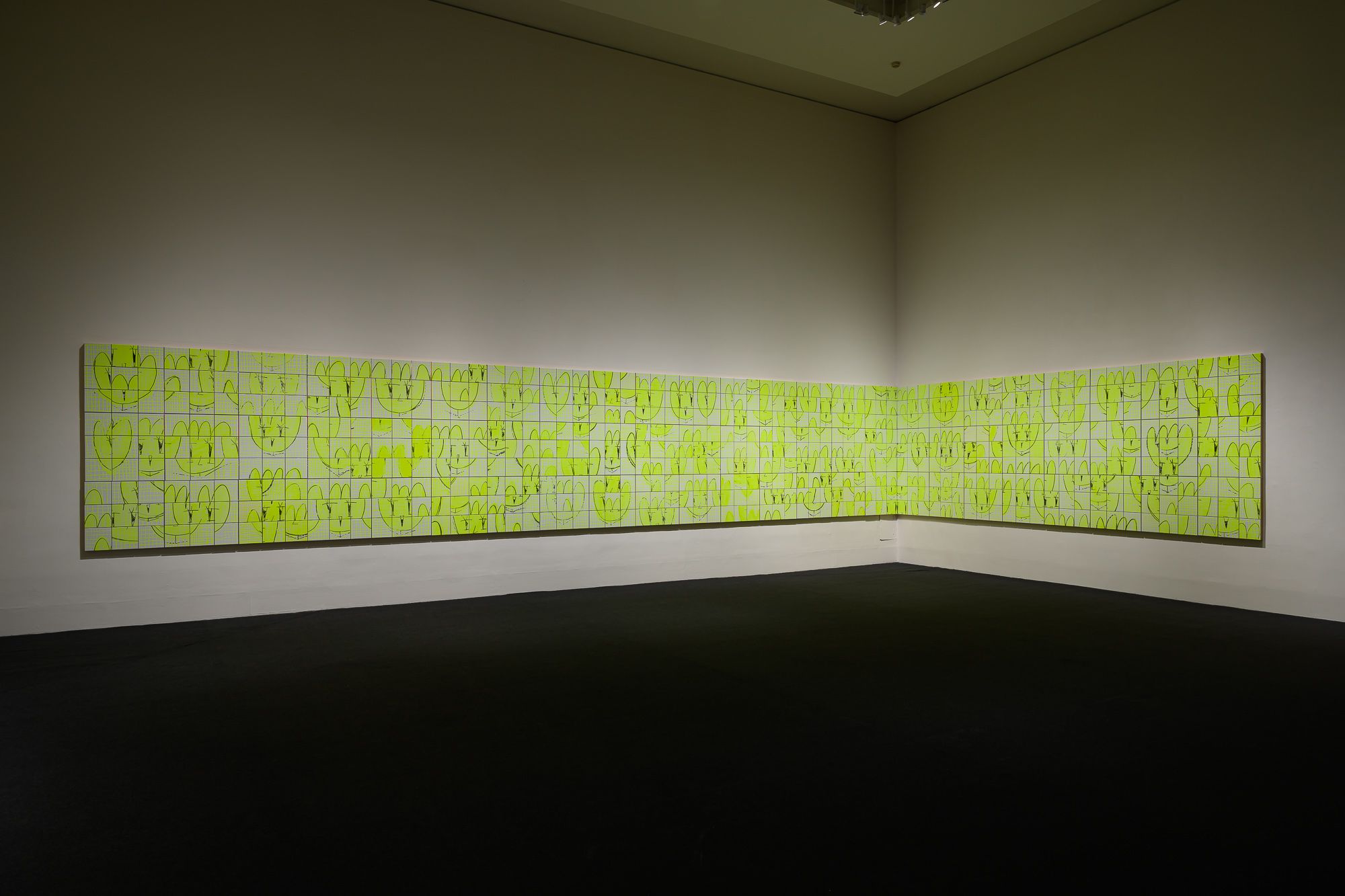
First Prize: Lee Fang-Yu, White Ceramic Tiles, Flower, Gap, acrylic, charcoal, laser stickers, white ceramic tiles, 184×1475.5×6 cm, 2025. (Photo courtesy of CTBC Foundation for Arts and Culture.)
Only when freedom is felt once again do we suddenly realize that freedom is not an effortless state, but a capability that requires practice. Much like how a fully grown adult—having witnessed the realities of the world—can still fall asleep in seconds upon closing their eyes, a feat envied as a true 'ability' by insomniacs. The charm of ‘Kawaii’ from Lee’s flowers rekindles the viewer's passion to create with their own hands, signaling that one's capacity to perceive the world has been unlocked once more. While this might not have been the artist’s explicit intention, it stands as the most singular revelation left in the wake of her award-winning work.
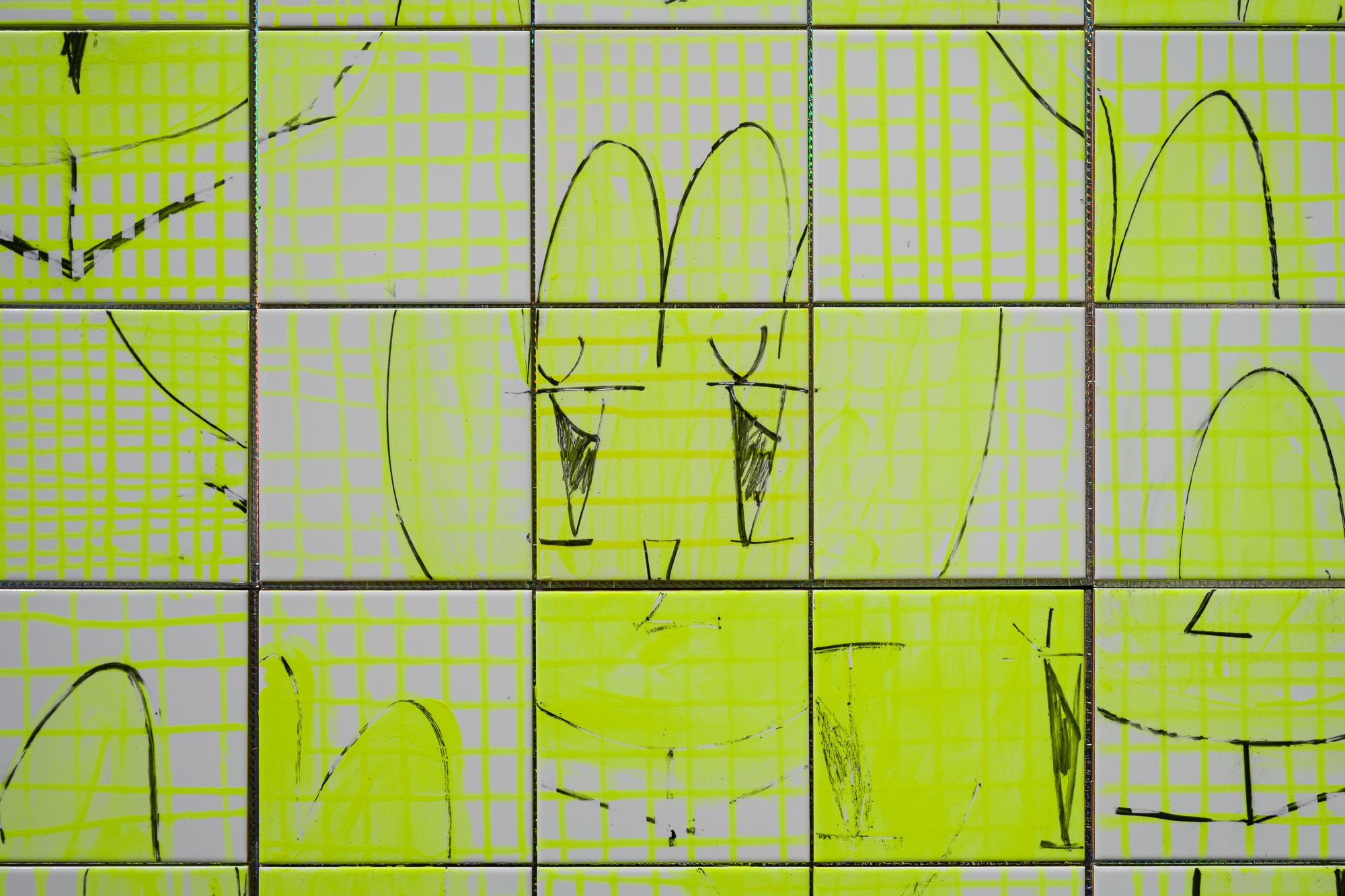
First Prize: Lee Fang-Yu, White Ceramic Tiles, Flower, Gap (detail). (Photo courtesy of CTBC Foundation for Arts and Culture.)
When we say painters spend most of their time and energy conversing with materials, it is more precise to describe it as a continuous process of transformation—one through which raw material gradually manifests as materiality. This evolution encompasses both technical control and the intervention of chance; it is simultaneously the labor of the hand and the construction of a way of seeing. Thus, when an artist speaks endlessly about their 'process,' it is not for lack of a story to tell or emotion to confide. Rather, it is because only through an intimate understanding of materiality can one unlock the exclusive content reserved for 'Close Friends.'
A morning when sunlight trickles across rumpled bedding; a lazy afternoon beneath dappled tree shadows; a twilight dusk where shadows hang at one's heels……Beyond any reliance on narrative, how can an image come into being through such moments alone? Huang Kuan-Chun’s Spaces of Presence and Absence offers a precise, ‘direct-hearted’ attempt, and also represents the fruition of his transformation after training in sculpture and fiber dyeing. When komorebi—the sunlight filtering through leaves—becomes an integral element of the work itself, the spatiotemporal variations of each exhibition space are likewise subsumed into the artwork’s essence. In other words, the ontology of the work extends beyond the tangible object to encompass the ways light and time permeate it, rendering every encounter an unrepeatable, living moment. This continues the ontological inquiry into painting's 'exhaustive utility of materials' that Huang has pursued since his 2020 solo exhibition, ‘Objectified Colors.’
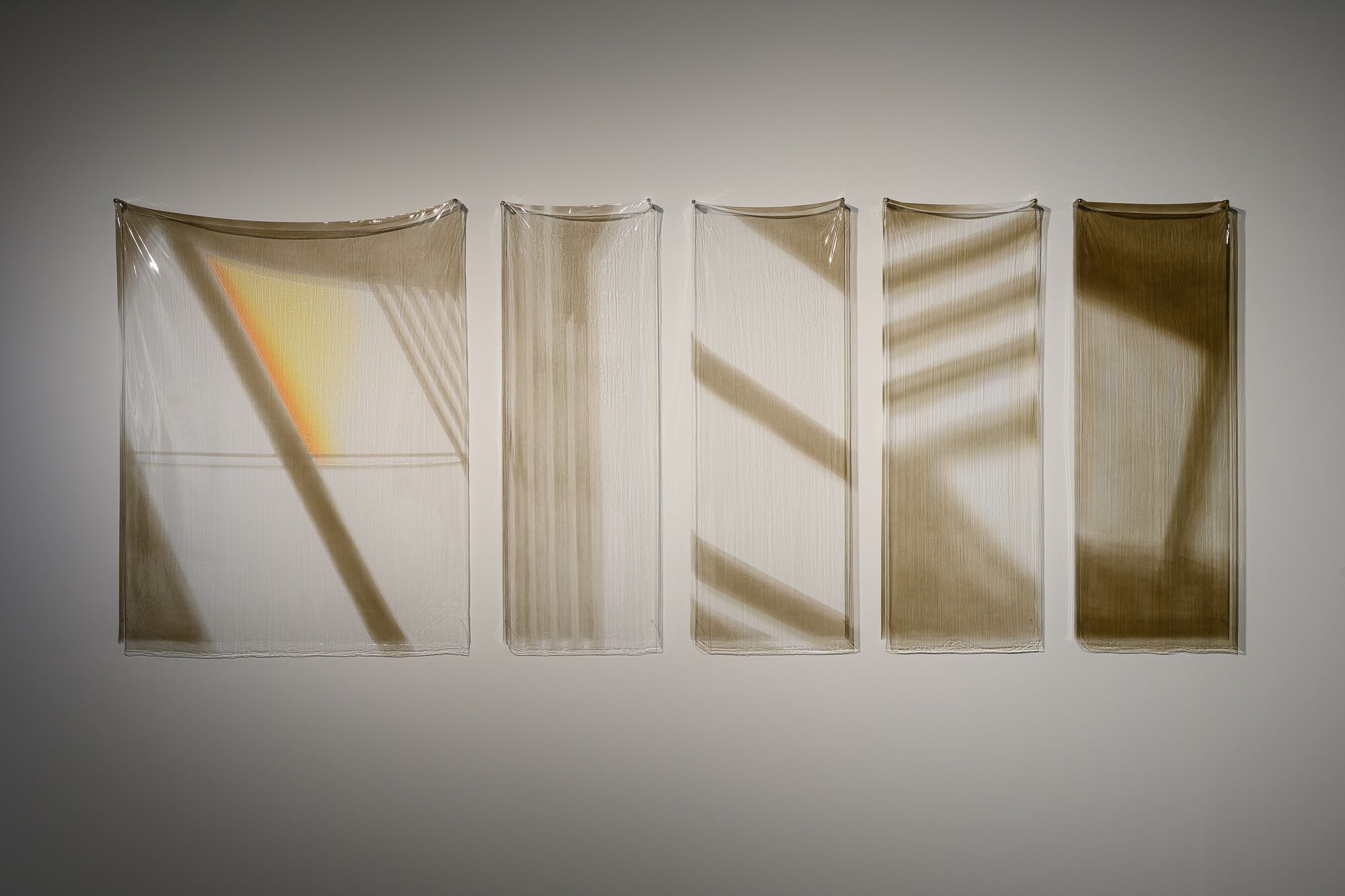
Merit Prize: Huang Kuan-Chun, Space of Presence and Absence, acrylic ink, acrylic medium, 108×264×6 cm, 2025. (Photo courtesy of CTBC Foundation for Arts and Culture.)
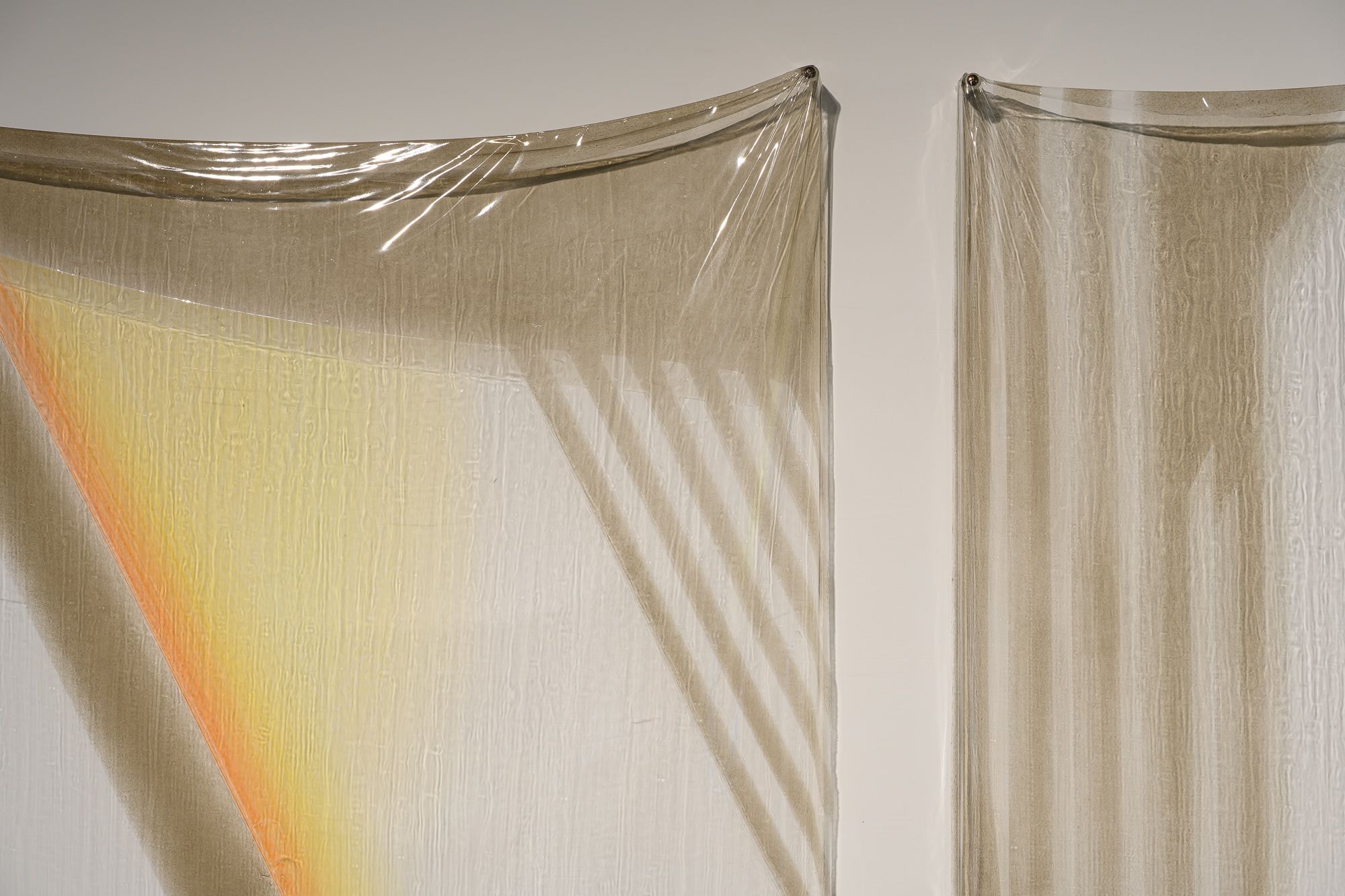
Merit Prize: Huang Kuan-Chun, Space of Presence and Absence (detail). (Photo courtesy of CTBC Foundation for Arts and Culture.)
Chang Hao-Yu’s work embodies a firm commitment to the materiality of painting alongside a continuous exploration of artistic discourse. His creative trajectory subtly reflects the path of many young Taiwanese artists under the academic examination system—a process of quiet dormancy giving way to liberation in free creation. At first glance, Beginning with Water… Then a Simulated Narrative features layered textures reminiscent of egg tempera and fresco, exuding a quality of deep introspection and slowness. Upon closer inspection, however, one reveals that the canvas itself is an unstretched 'semi-finished product' presented as the 'finished work.' Embedded in the lower left of this semi-finished piece is a hand-painted motif of a mother and child—a painting within a painting, a draft within a draft—foreshadowing the former life of this unfinished state. Yet the most ideal artwork remains an 'imagined painting' completed in the mind of each viewer on their own terms—where the artist's iterative sketches and smeared brushstrokes serve as guides, charting the generative pathways of imagination."
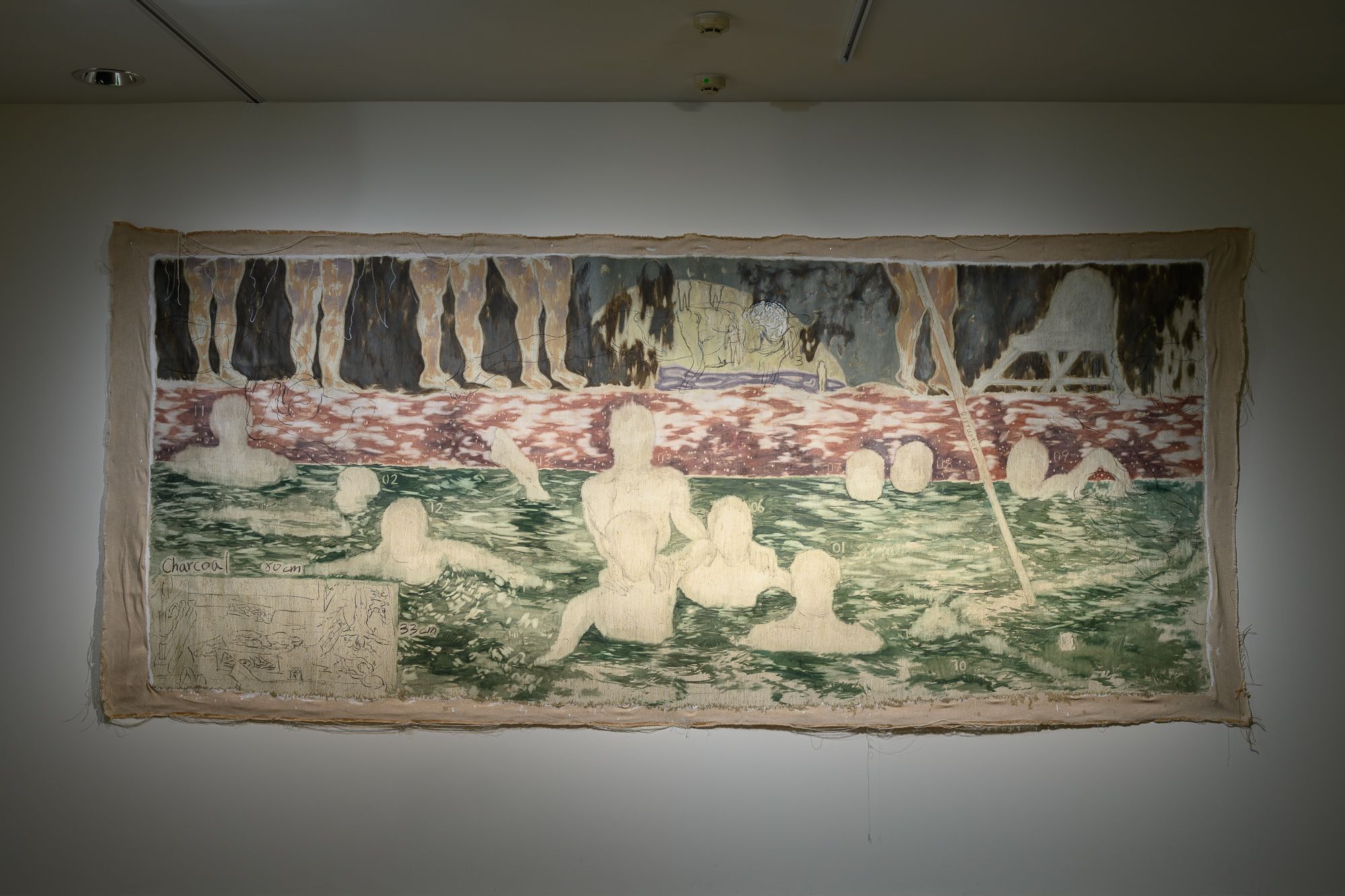
Merit Prize: Chang Hao-Yu, Beginning with Water… Then a Simulated Narrative, Oil paint, charcoal on canvas, 155×360×0.1 cm, 2025. (Photo courtesy of CTBC Foundation for Arts and Culture.)
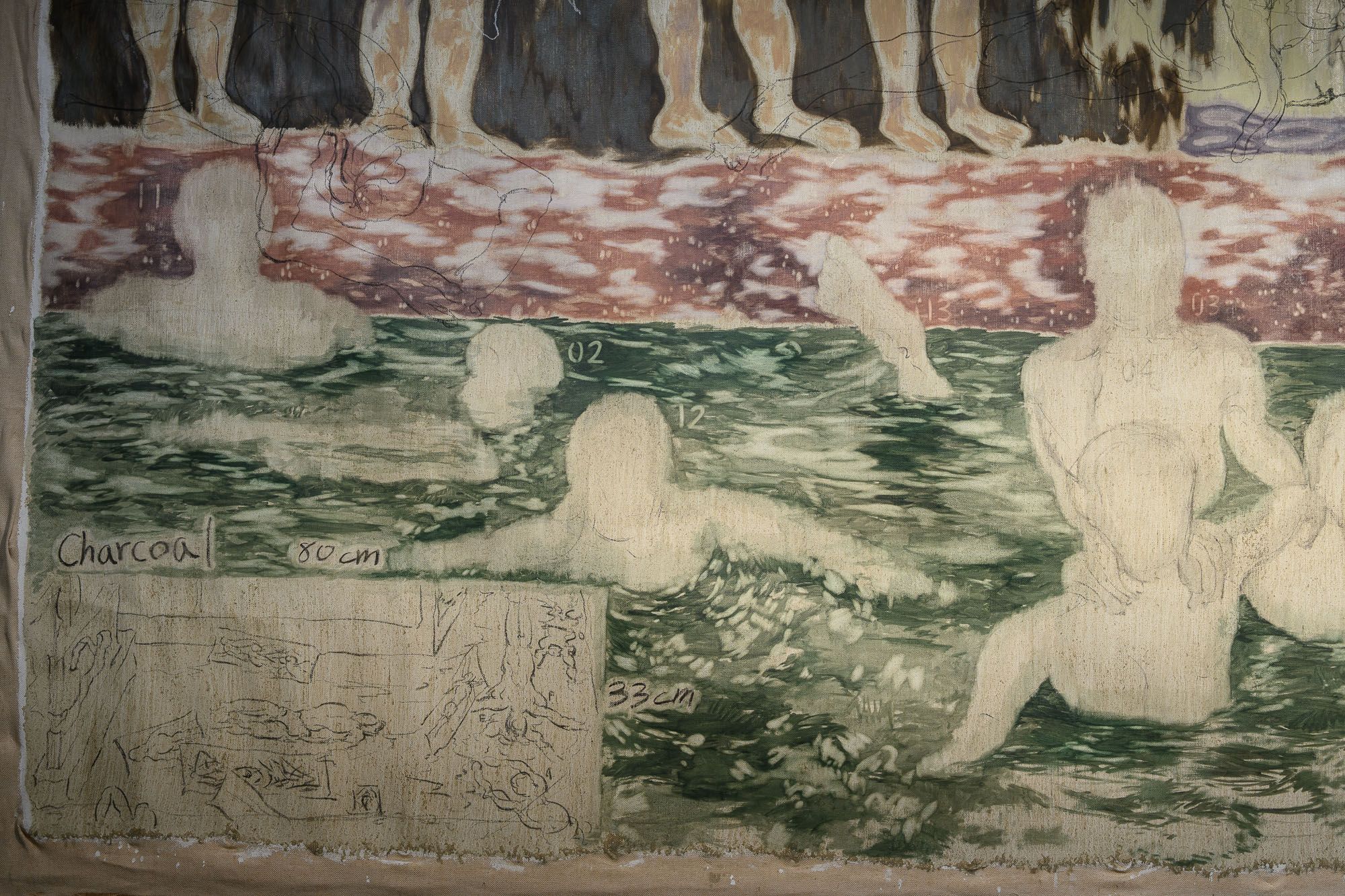
Merit Prize: Chang Hao-Yu, Beginning with Water… Then a Simulated Narrative (detail). (Photo courtesy of CTBC Foundation for Arts and Culture.)
Aesthetics of representation are often viewed as 'tradition'—and for most people, the question of verisimilitude ('does it look real?') remains the most intuitive standard for understanding a painting. Throughout art history, ‘trompe-l'oeil’ served varied purposes: religious devotion, royal eulogy, or scientific documentation. Among the ambiguous methods of visual rendering, directness does not equal efficacy; yet realism invariably invites us to knowingly play along, suspended between belief and skepticism. Huang Chia-Ning’s Cactus Segment (Monkey Tail Cactus) captures a corner of everyday life easily overlooked. Yet when a forgotten corner expands into a landscape, the artist's buffer zone ceases to be private, becoming shared instead. With an even-tempered rhythm of brushstrokes and a soft layering of lingering brush marks navigating between the cactus's needle-like spines, 'texture' transitions from being seen to being felt. Softness and hardness are re-perceived only after a tactile sense has been generated. Uniquely, Huang's painting loosens the curse of high-definition while simultaneously seizing the viewer’s obsession with—and pleasure in—exquisite detail.
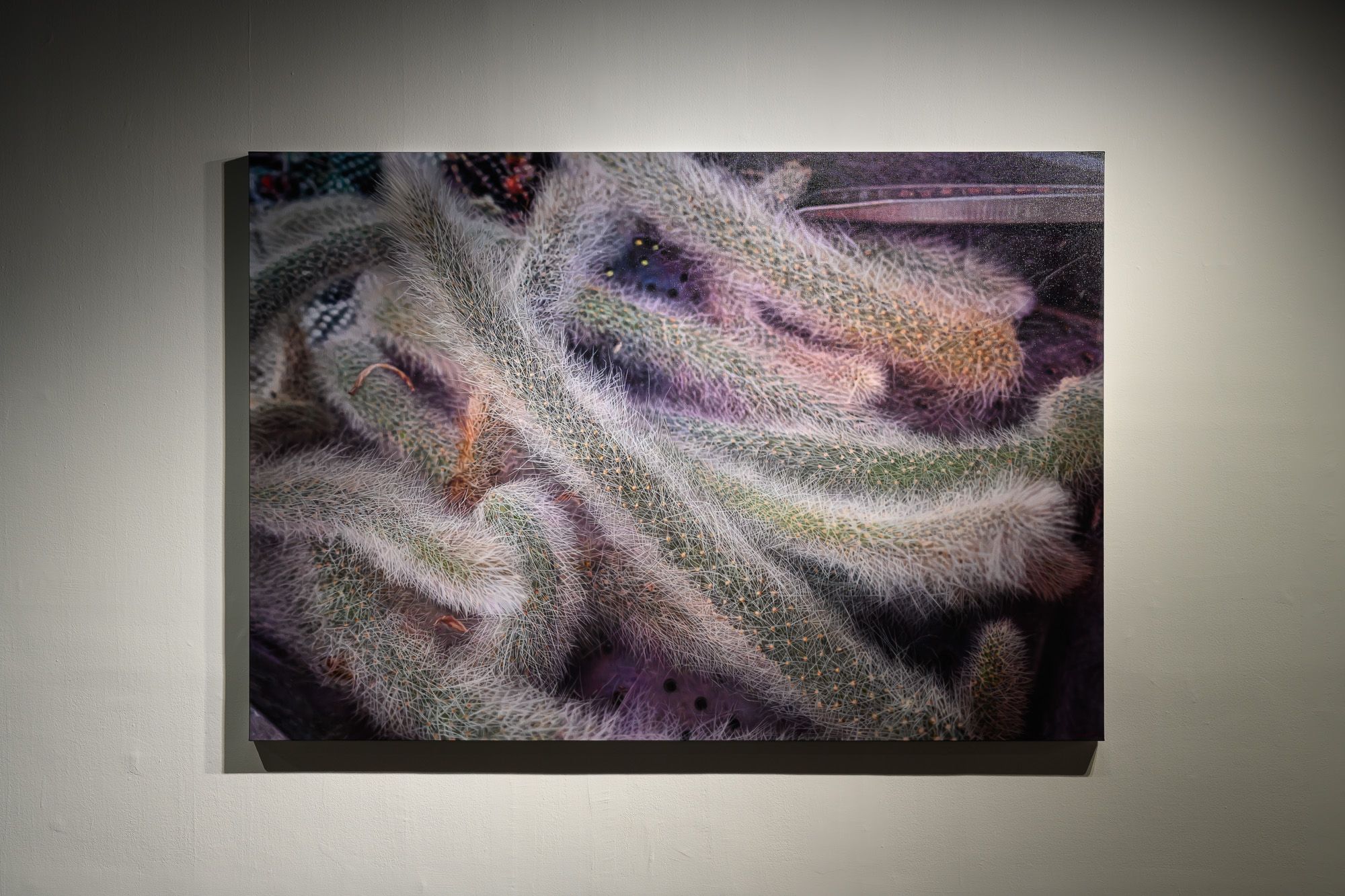
Merit Prize: Huang Chia-Ning, Cactus Segment (Monkey Tail Cactus), oil on canvas, 154×223×5 cm, 2025. (Photo courtesy of CTBC Foundation for Arts and Culture.)
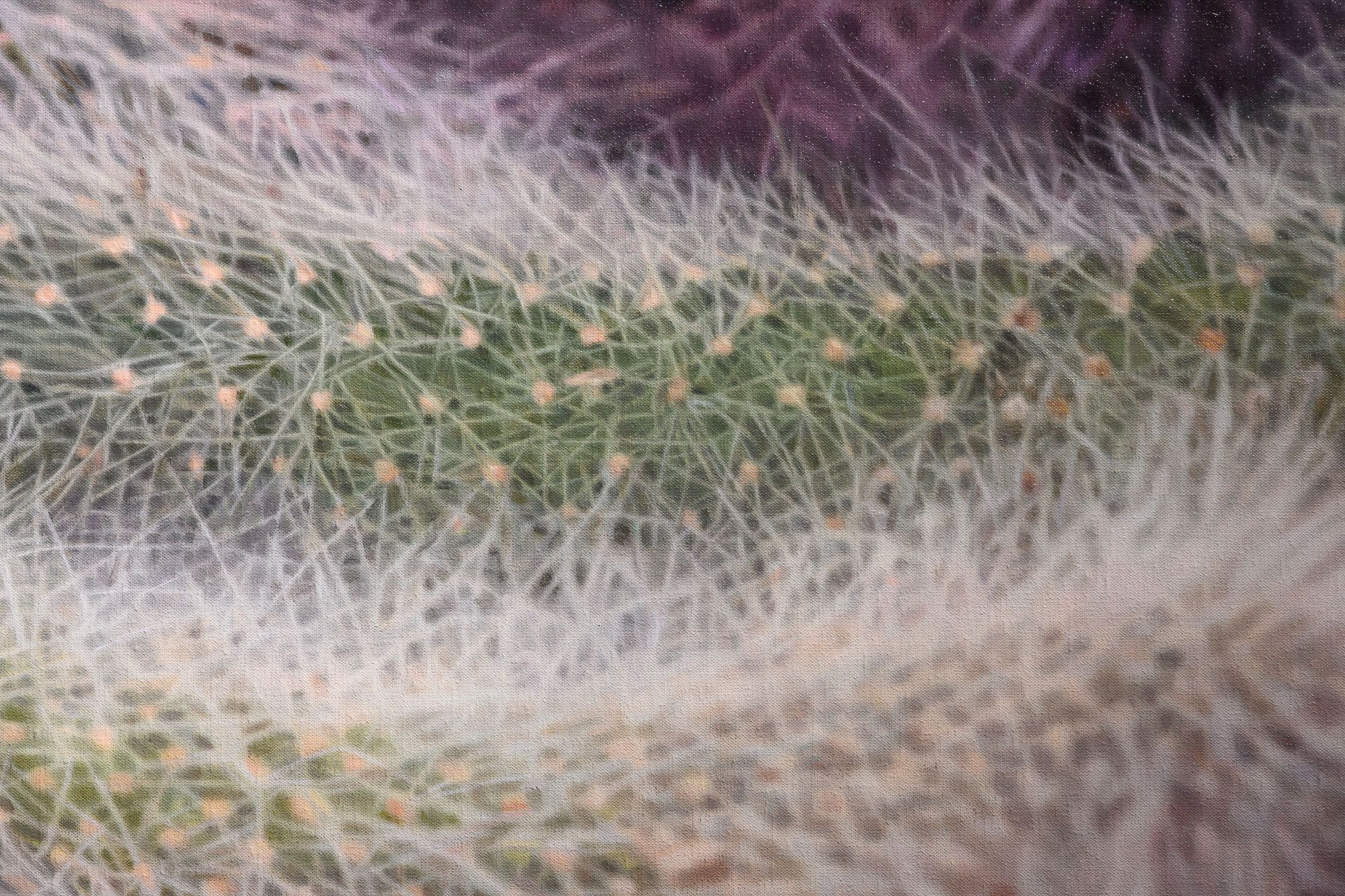
Merit Prize: Huang Chia-Ning, Cactus Segment (Monkey Tail Cactus) (detail). (Photo courtesy of CTBC Foundation for Arts and Culture.)
The three Merit Prize recipients each point toward distinct painterly genres, along with the contexts and propositions they carry. One rests upon a relatively traditional realist framework that, ironically, struggles to gain visibility within contemporary discourse; another veers into the experiments in material and form, embarking on uncommon or even risky artistic trajectories. Regardless of their positioning, each represents a different facet of adventure: for the former, it is a quest to reclaim visibility within an established language; for the latter, a foray beyond boundaries to test new possibilities. Within Taiwan’s existing competition system, every genre faces different conditions of viewing and evaluative dilemmas—realism is no longer taken for granted, while experimentation is not always fully recognized. Precisely because of this, such adventures simultaneously pose a challenge to the organizers: as the boundaries of painting are stretched open again, can the jury mechanism expand accordingly? Within this tension, a re-understanding of the works is generated, bringing necessary stimulation and breakthroughs to the overall jury perspective.
The shortlisted artists represent a microcosm of the generational spectrum in Taiwanese painting. There are artists with accumulated experience maturing in the art world, as well as emerging creators making their debut. The differing ranks awarded to various artists across awards highlight not only differences in jury perspectives, but also the continuous fluid and renewing energy of Taiwan's painting scene.
The 'sense of image' and 'sense of the digital' in painting are not mere representations of digital experience; rather, they transform painting into a reflective mechanism. Lu Guan-Hong’s Apocalypse Now: Writing, Empowerment, Spirit-Listening, and Walking Words, Hsiao Tsan-Chun’s Forgetting Where to Begin, Wang Po-Chin’s New System Sample 6: How to Cut Milk, and Huang Ko-Wei’s Tinder each articulate everyday life or visual experiences under the influence of contemporary media. Lu Guan-Hong and Hsiao Tsan-Chun fuse historical archives with real-world textbook illustrations, news footage, daily streetscapes, or urban corners. Wang Po-Chin utilizes heavily impastoed, textured paint to layer characteristics of internet memes and pixelated imagery, while Huang Ko-Wei’s work demonstrates how individual desires fluctuate with the operation of digital tools, thoughts shifting in a snap. These works present the logic of digital image generation and circulation, contrasting and permeating with painting’s own generative mechanisms, thereby revealing the ongoing translation and re-encoding process of contemporary painting under the dominance of image culture.
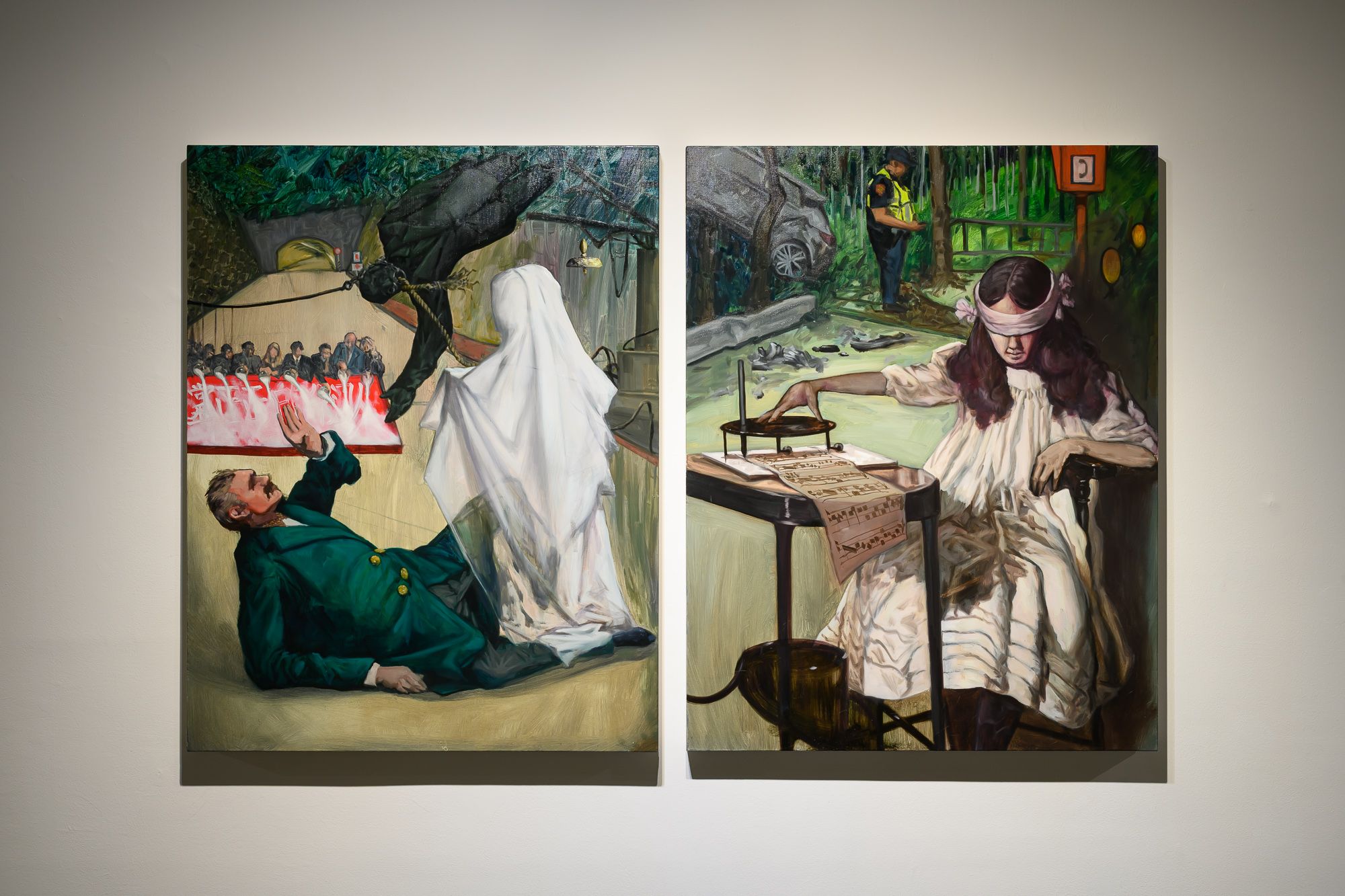
Honorable Mention: Lu Guan-Hong, Apocalypse Now: Writing, Empowerment, Spirit-Listening, and Walking Words, oil on canvas, 116.5×182×5 cm, 2025. (Photo courtesy of CTBC Foundation for Arts and Culture.)
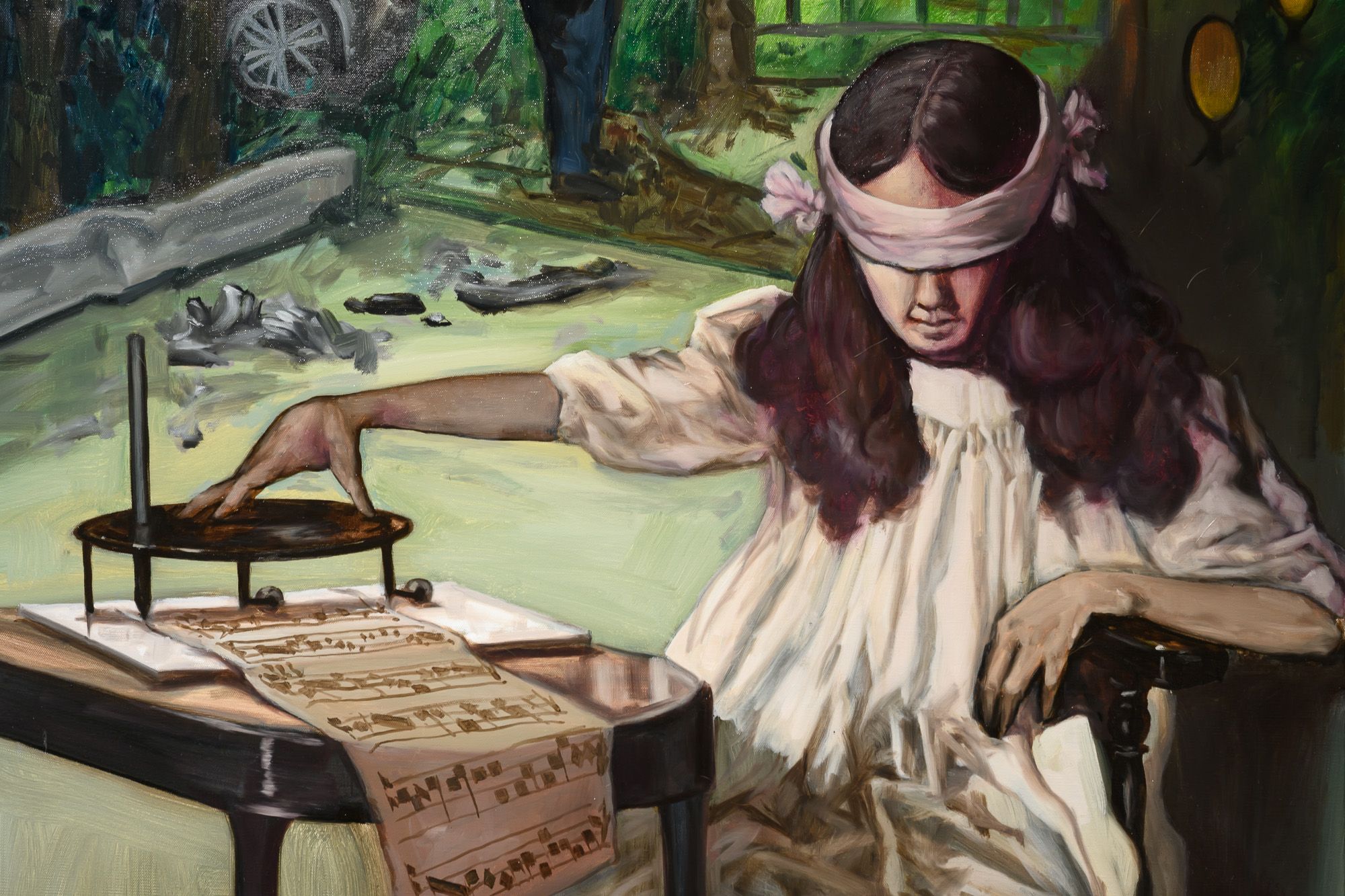
Honorable Mention: Lu Guan-Hong, Apocalypse Now: Writing, Empowerment, Spirit-Listening, and Walking Words (detail). (Photo courtesy of CTBC Foundation for Arts and Culture.)
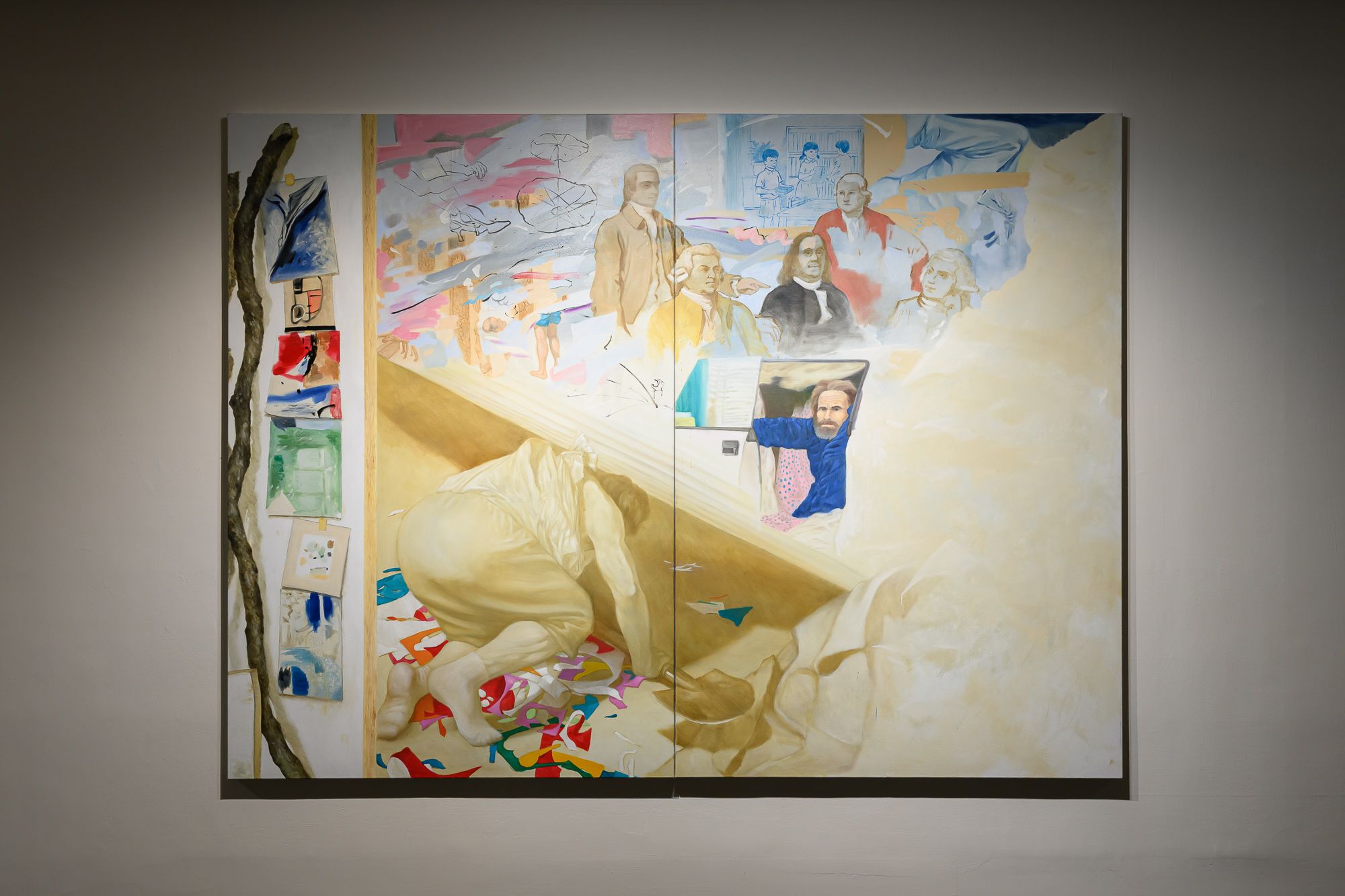
Honorable Mention: Hsiao Tsan-Chun, Forgetting Where to Begin, oil on canvas, 194×260×3 cm, 2025. (Photo courtesy of CTBC Foundation for Arts and Culture.)
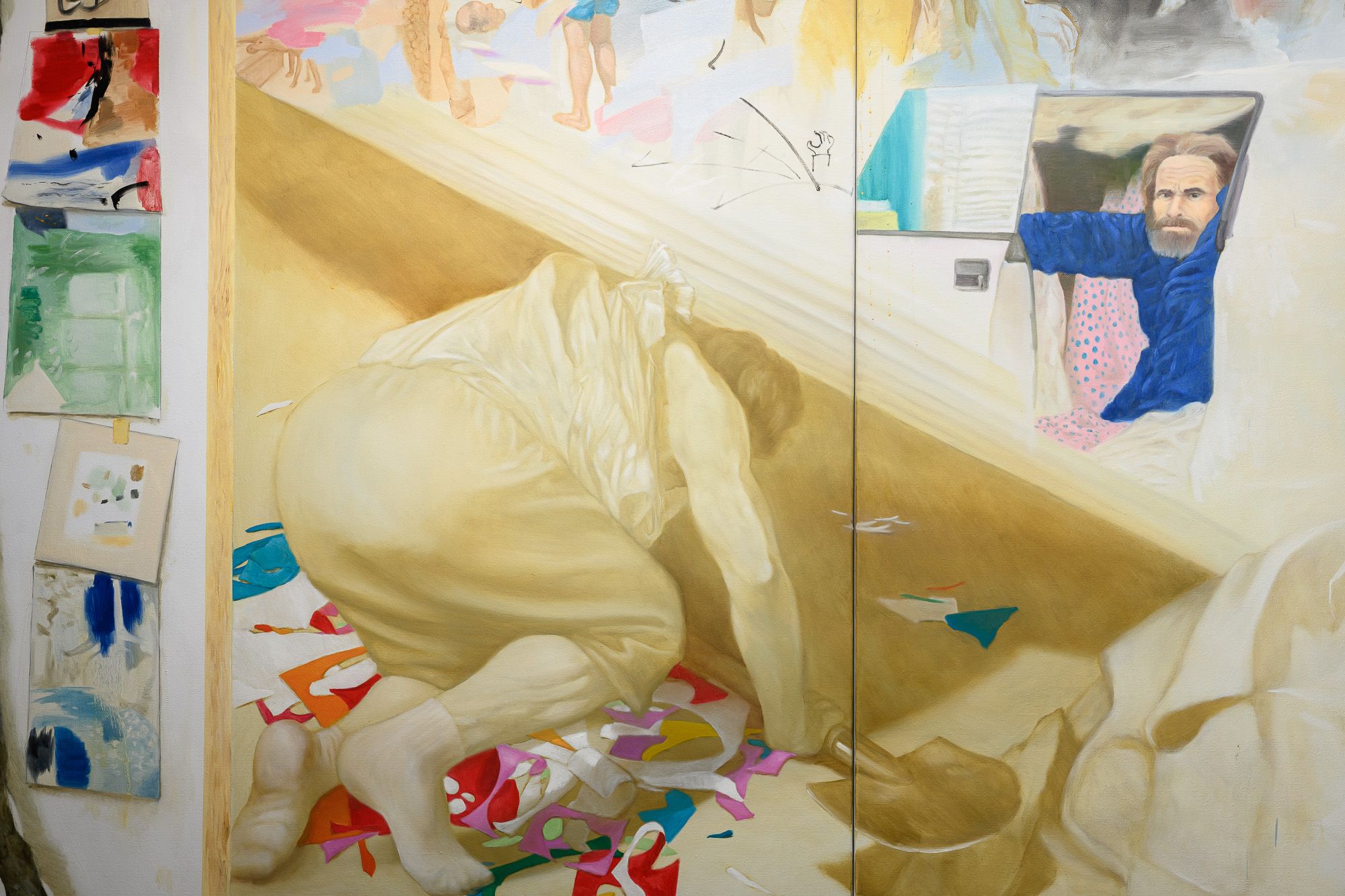
Honorable Mention: Hsiao Tsan-Chun, Forgetting Where to Begin (detail). (Photo courtesy of CTBC Foundation for Arts and Culture.)
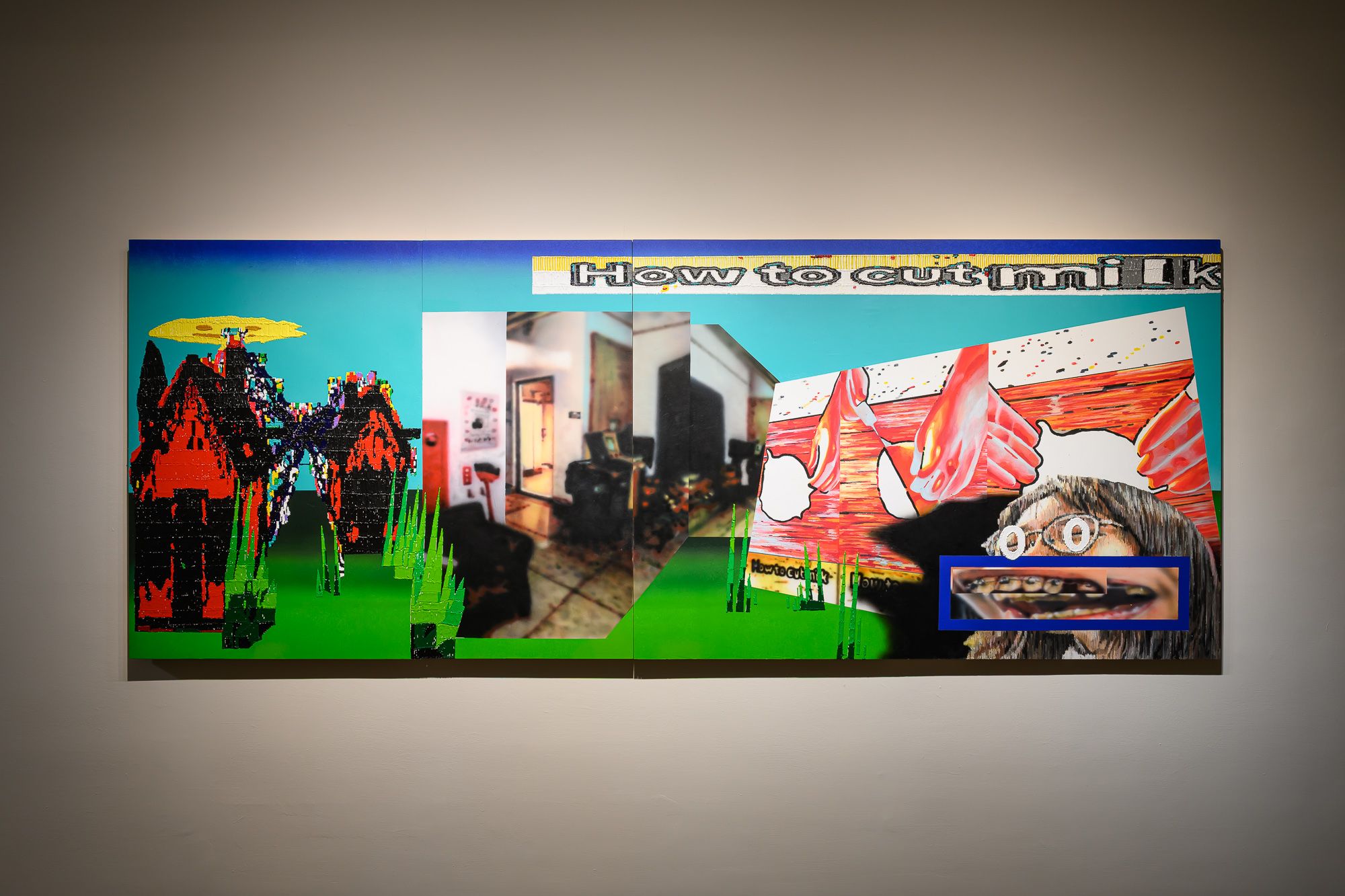
Honorable Mention: Wang Po-Chin, New System Sample 6: How to Cut Milk, oil pastel, acrylic, 110×286×3 cm, 2025. (Photo courtesy of CTBC Foundation for Arts and Culture.)
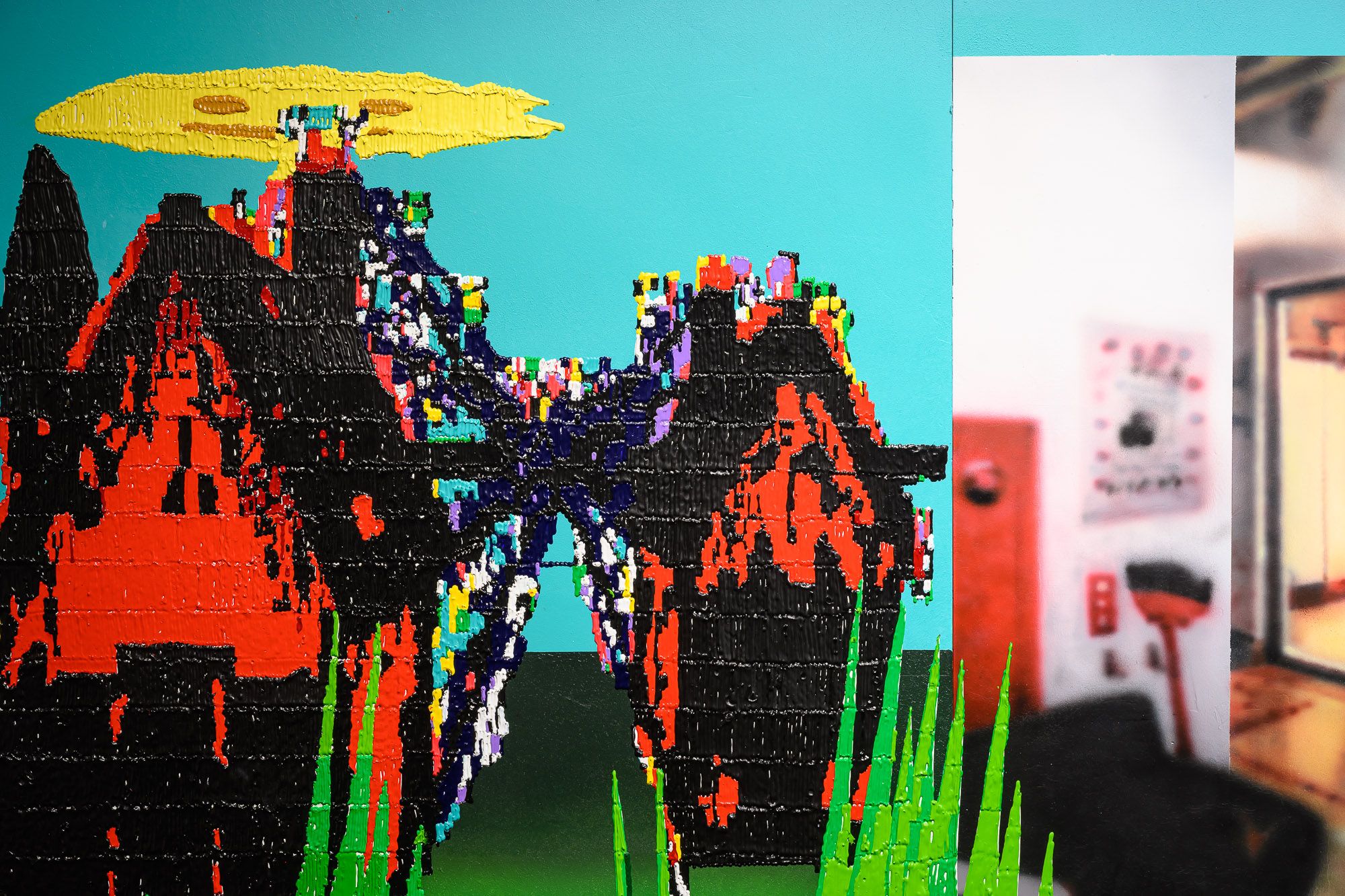
Honorable Mention: Wang Po-Chin, New System Sample 6: How to Cut Milk (detail). (Photo courtesy of CTBC Foundation for Arts and Culture.)
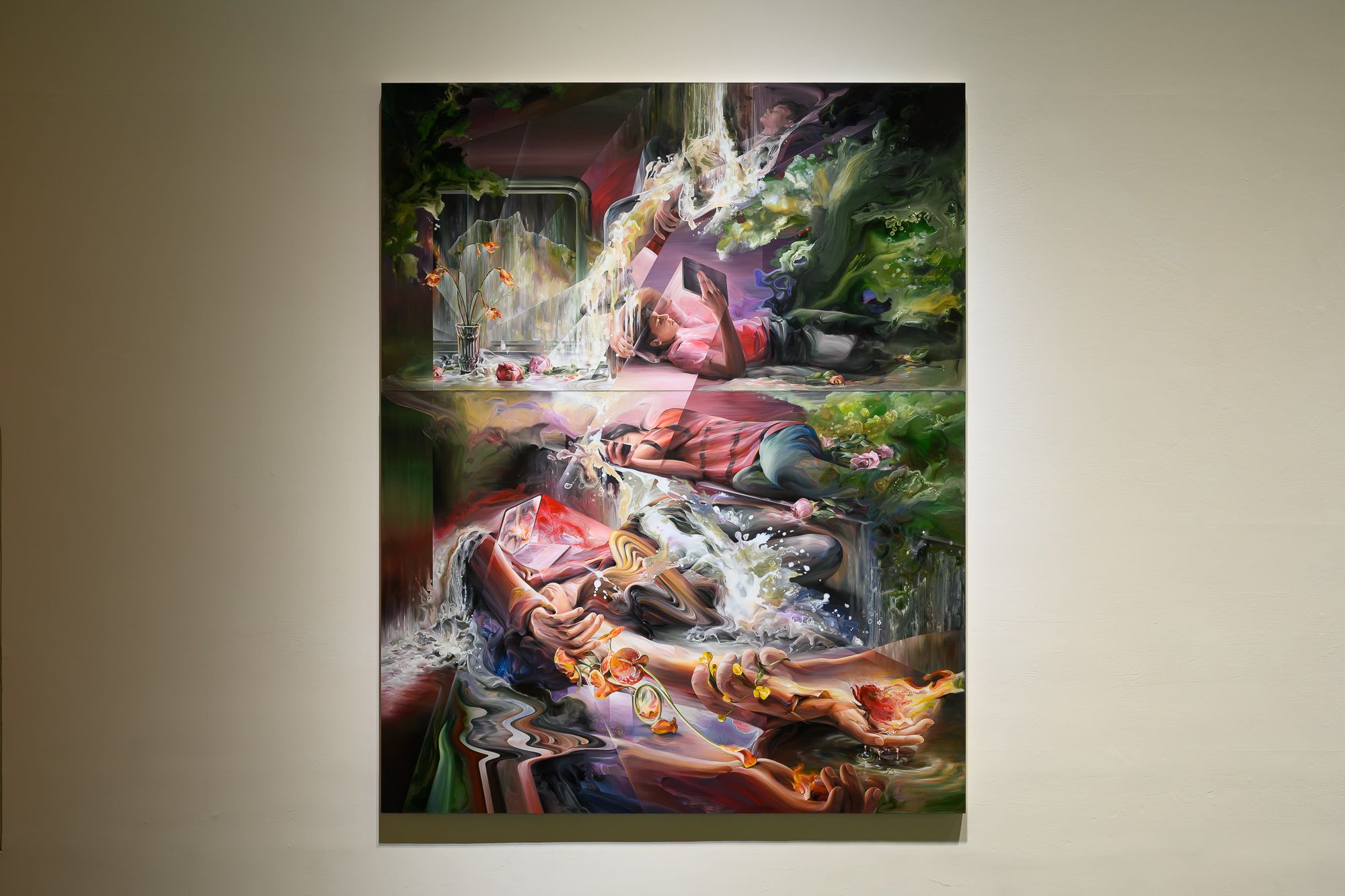
Honorable Mention: Huang Ko-Wei, Tinder, acrylic on canvas, 225×180×5 cm, 2025. (Photo courtesy of CTBC Foundation for Arts and Culture.)
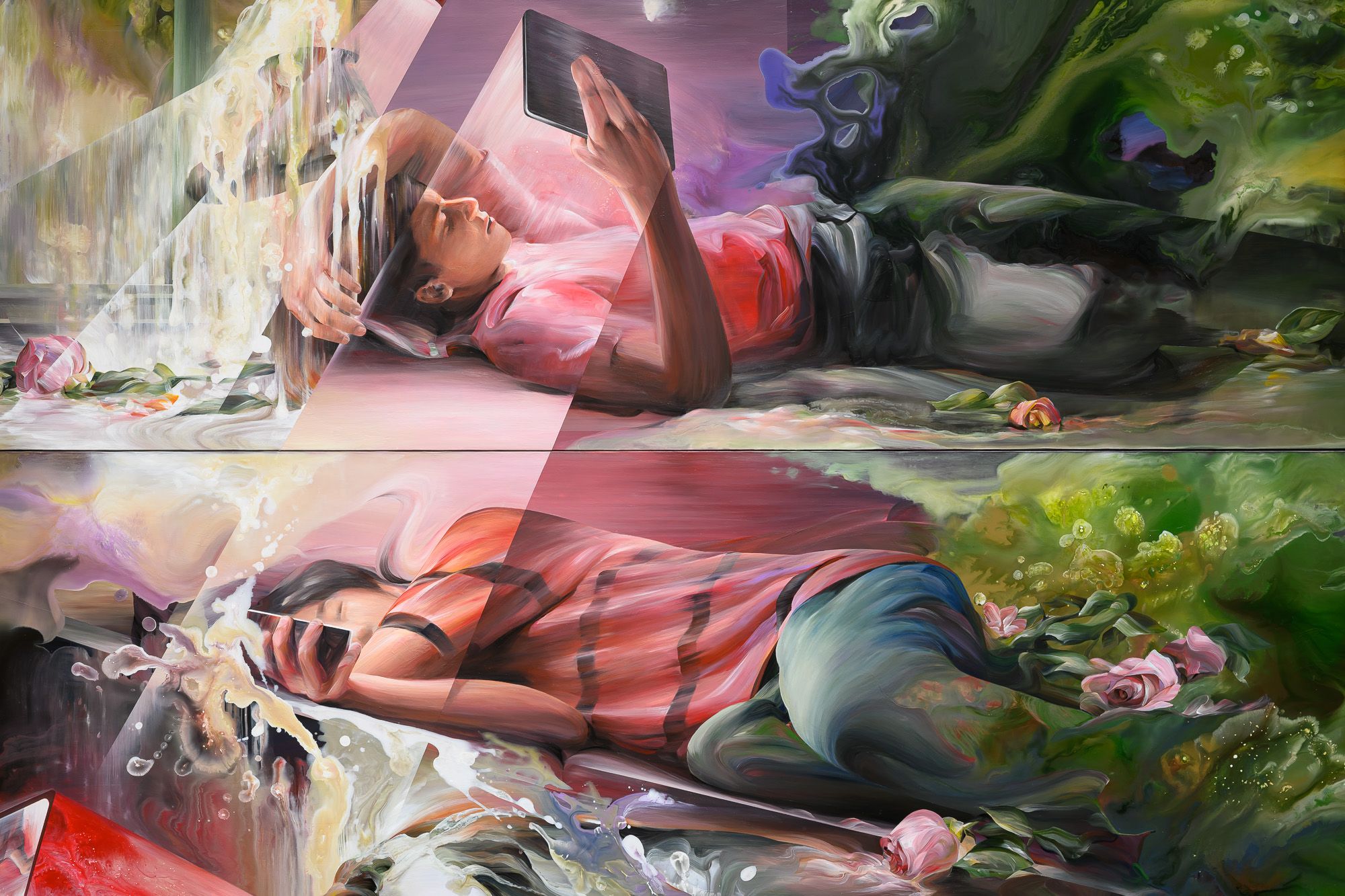
Honorable Mention: Huang Ko-Wei, Tinder (detail). (Photo courtesy of CTBC Foundation for Arts and Culture.)
Distinct from the aforementioned image worlds, Yan Jheng-Hao's Coming from Faraway Lands, Chin Ko's Seven Fairies, and Wen Chia-Ning's We Are More Similar than Different present a highly personalized rumination filled with strong bodily sensation, social perception, and gender consciousness. The very existence of these works acts as a glaring object within the established normative order. Yan Jheng-Hao employs the ‘moon’ as a symbol converging technology, sensibility, desire, and cultural memory. Chin Ko appropriates the legend of the Seven Fairies using shower curtains as a medium, generating an ambiguous voyeuristic experience through floating curtains and gaps in space. Meanwhile, Wen Chia-Ning constructs a viewing structure of interwoven concealment and reflection on film-covered canvas—featuring figures in black and white accented with fluorescent hues—referencing female conditions and satirizing social realities.
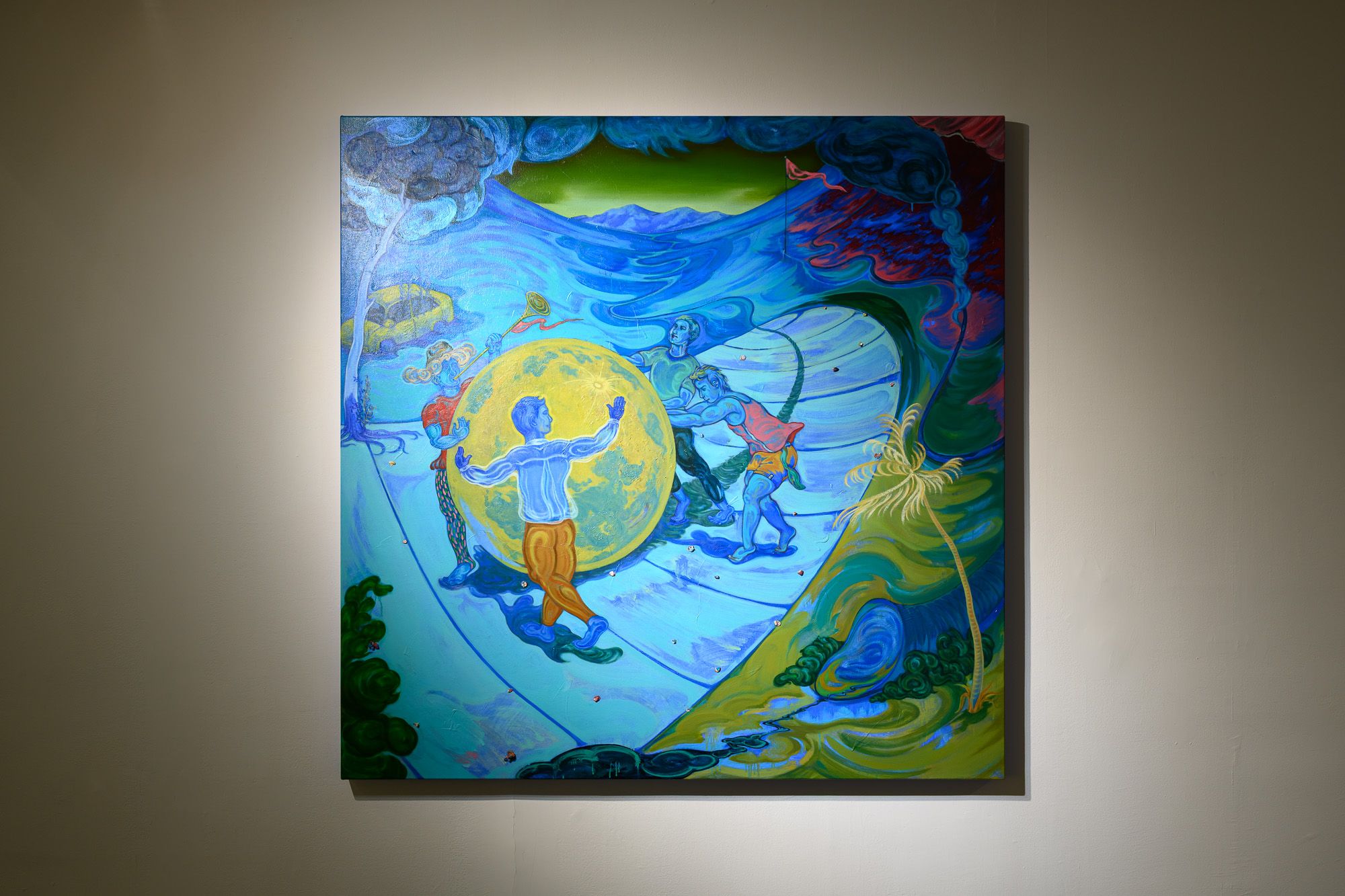
Honorable Mention: Yan Jheng-Hao, Coming from Faraway Lands, oil, acrylic on canvas, 150×150×5 cm, 2025. (Photo courtesy of CTBC Foundation for Arts and Culture.)
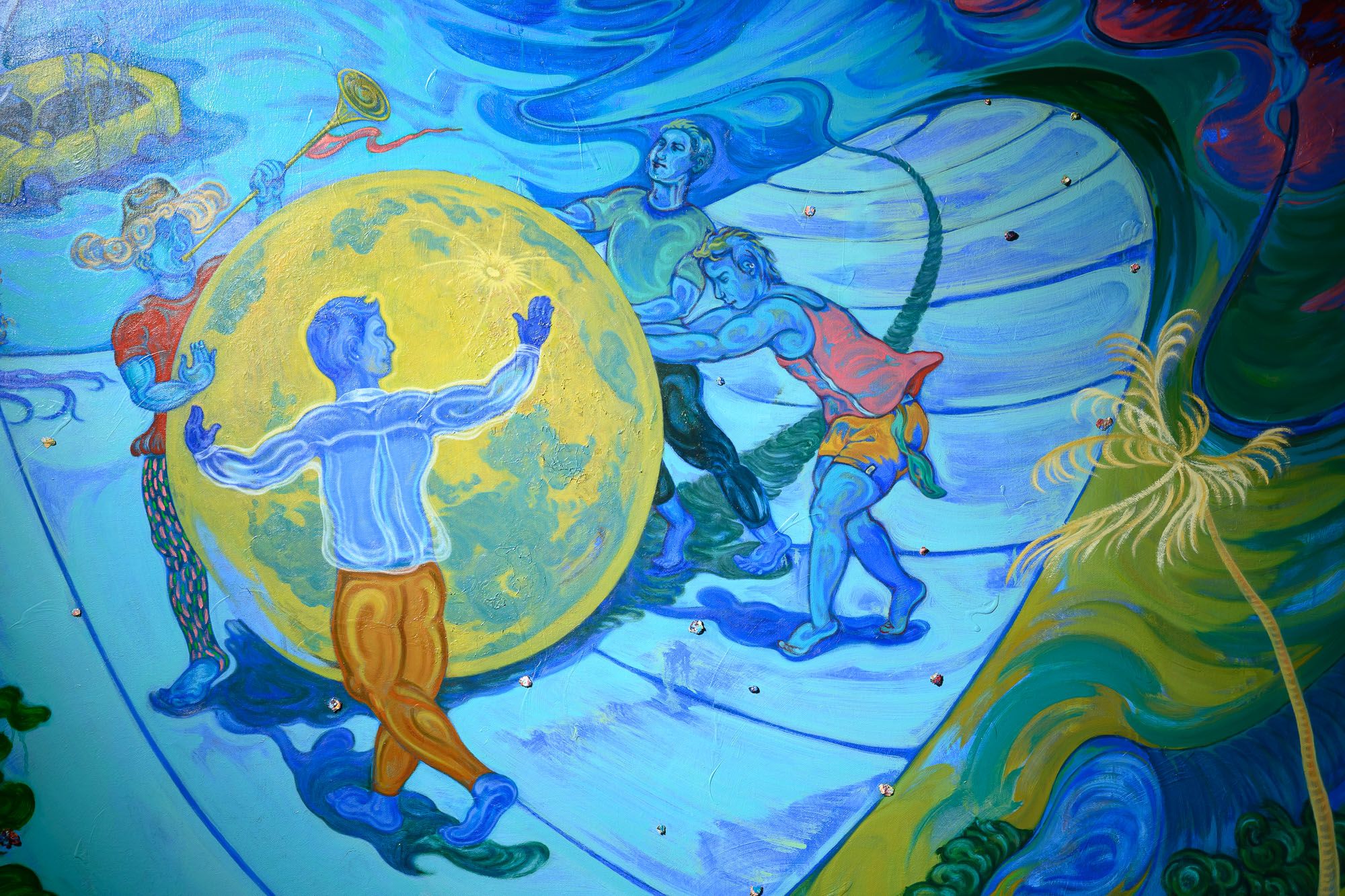
Honorable Mention: Yan Jheng-Hao, Coming from Faraway Lands (detail). (Photo courtesy of CTBC Foundation for Arts and Culture.)
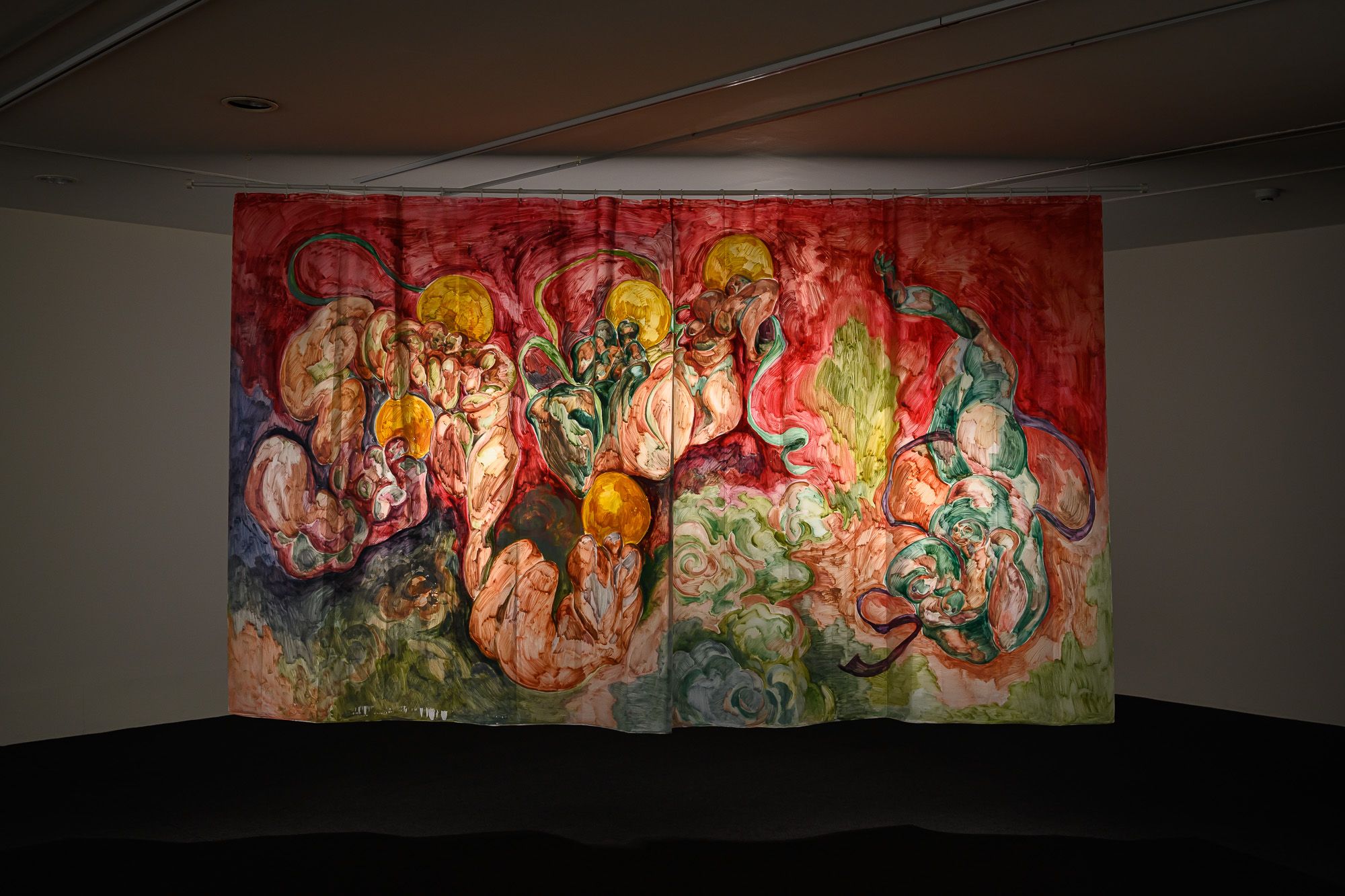
Honorable Mention: Chin Ko, Seven Fairies, oil, shower curtain, found object, 180×360×3 cm, 2025. (Photo courtesy of CTBC Foundation for Arts and Culture.)
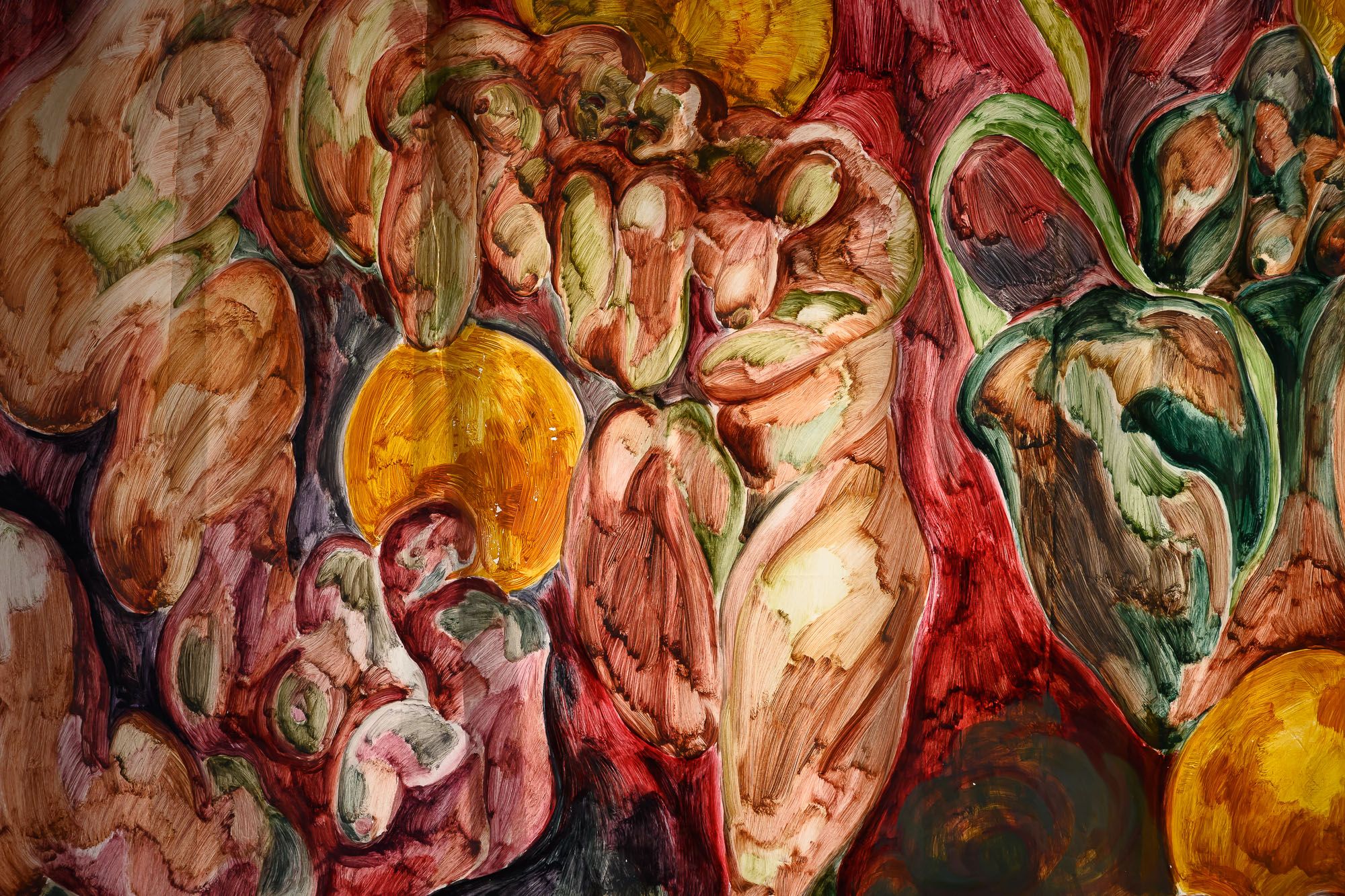
Honorable Mention: Chin Ko, Seven Fairies (detail). (Photo courtesy of CTBC Foundation for Arts and Culture.)
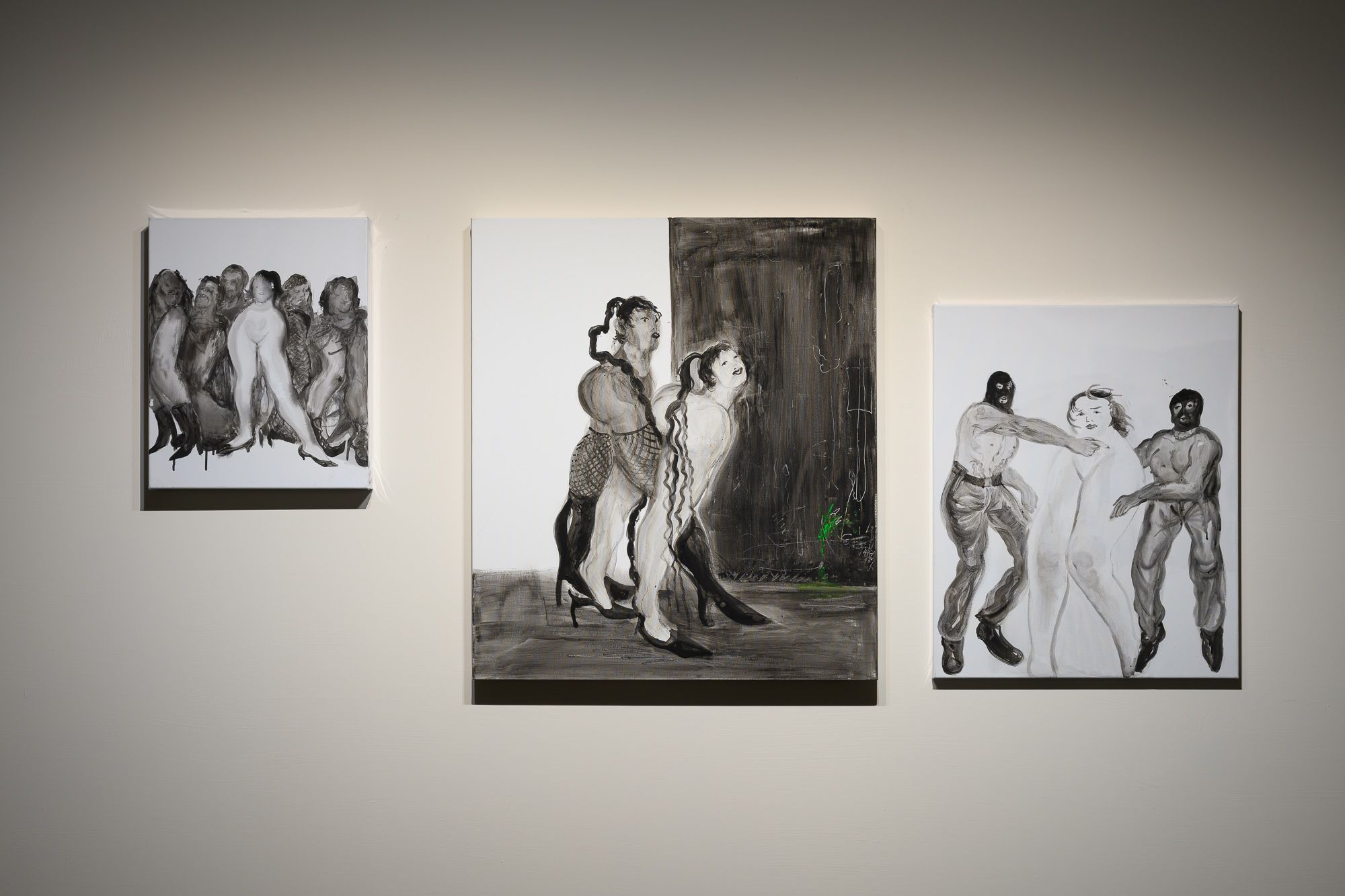
Honorable Mention: Wen Chia-Ning, We Are More Similar than Different, acrylic, crayon on canvas (partially covered with plastic film), 46.5×38×5 cm, 80×69.5×5 cm, 65×53×2.5 cm, 2025. (Photo courtesy of CTBC Foundation for Arts and Culture.)
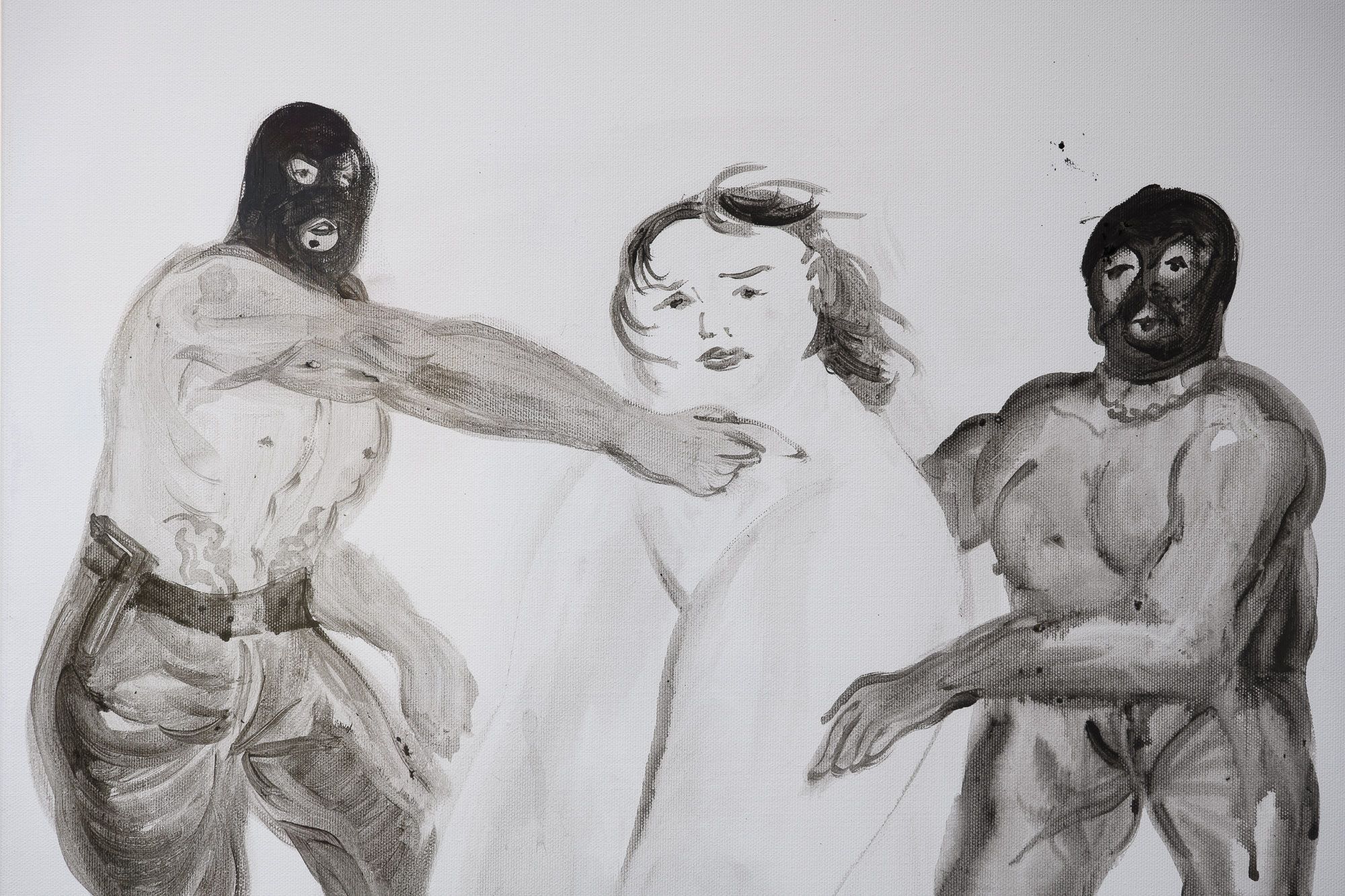
Honorable Mention: Wen Chia-Ning, We Are More Similar than Different (detail). (Photo courtesy of CTBC Foundation for Arts and Culture.)
The creations of Huang Yu-Huan, Grace Wu, Chou Kai-Lun, Lin Ying-Hsiu, Kuo Ping-En, Huang Chih-Cheng, and Yang Cheng-Yen are not mere landscapes and still lifes, yet each work brings forth its own unique scenic perspective. While calligraphic brush-and-ink is not a shared concern for all these artists, the gathering forged by this prize fosters engaging comparisons and intertextuality among their works.
Huang Yu-Huan’s Reality Gaze resembles a thrilling apocalypse steadily approaching the viewer atop overexposed film negatives; heavy paint coatings interact with a hazy depth of field, foretelling a critical state where vision is on the verge of collapse. Grace Wu’s painting M001 seems to pursue the texture of ultra-glossy photo paper prints through lacquerware craftsmanship; in meticulous grinding, paint layers turn into flowers blooming in the dark. Huang Chih-Cheng has long studied the art of leaf gilding; the metallic luster complements the subject of glass vessels holding liquid. In this large-scale still life, the curved liquid surface inside the glass becomes shimmering waves. Yang Cheng-Yen's work echoes his mountaineering viewing experiences within a vertical scroll format; adding wool to the substrate gives the picture a rough, fluffy texture, as if physically feeling the friction and resistance when traversing through vegetation. Huang Chih-Cheng’s Still Life and Yang Cheng-Yen’s Being Stare at Hugely seem to differ widely in theme, yet mirror each other in the microscopic perspective of their materials.
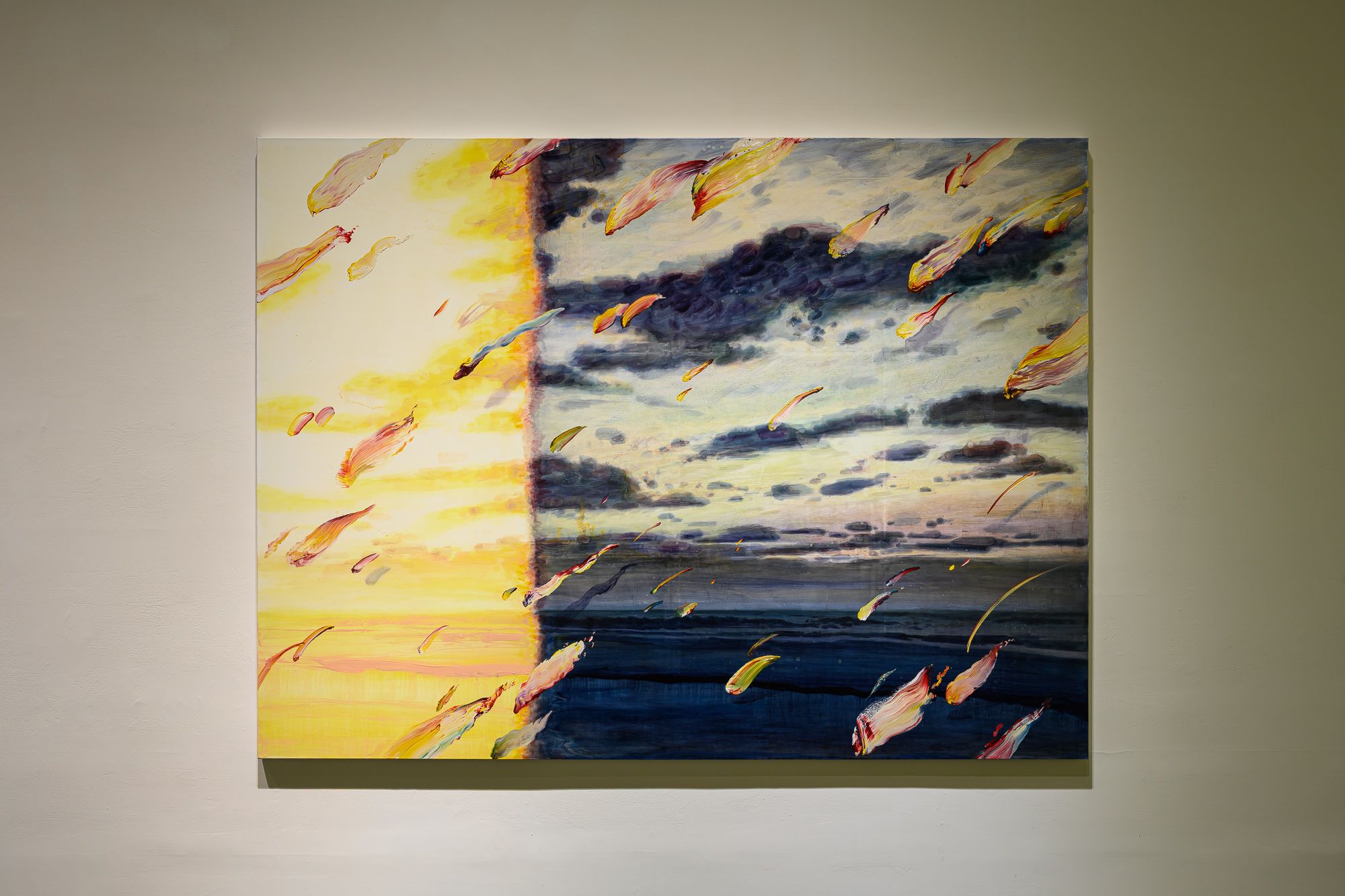
Honorable Mention: Huang Yu-Huan, Reality Gaze, pastel, acid-free resin, blending oil, oil on canvas, 194×259×5 cm, 2025. (Photo courtesy of CTBC Foundation for Arts and Culture.)
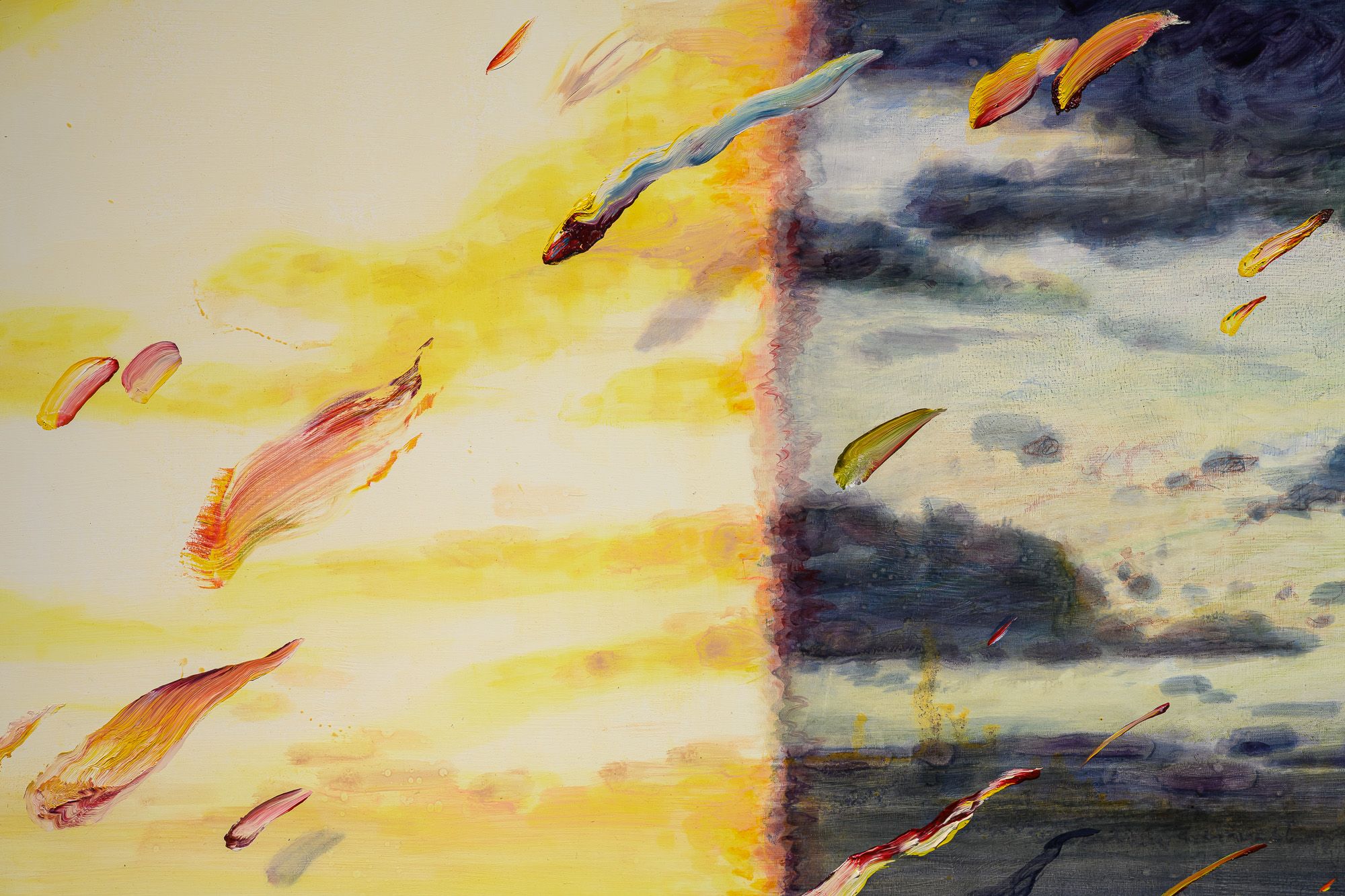
Honorable Mention: Huang Yu-Huan, Reality Gaze (detail). (Photo courtesy of CTBC Foundation for Arts and Culture.)
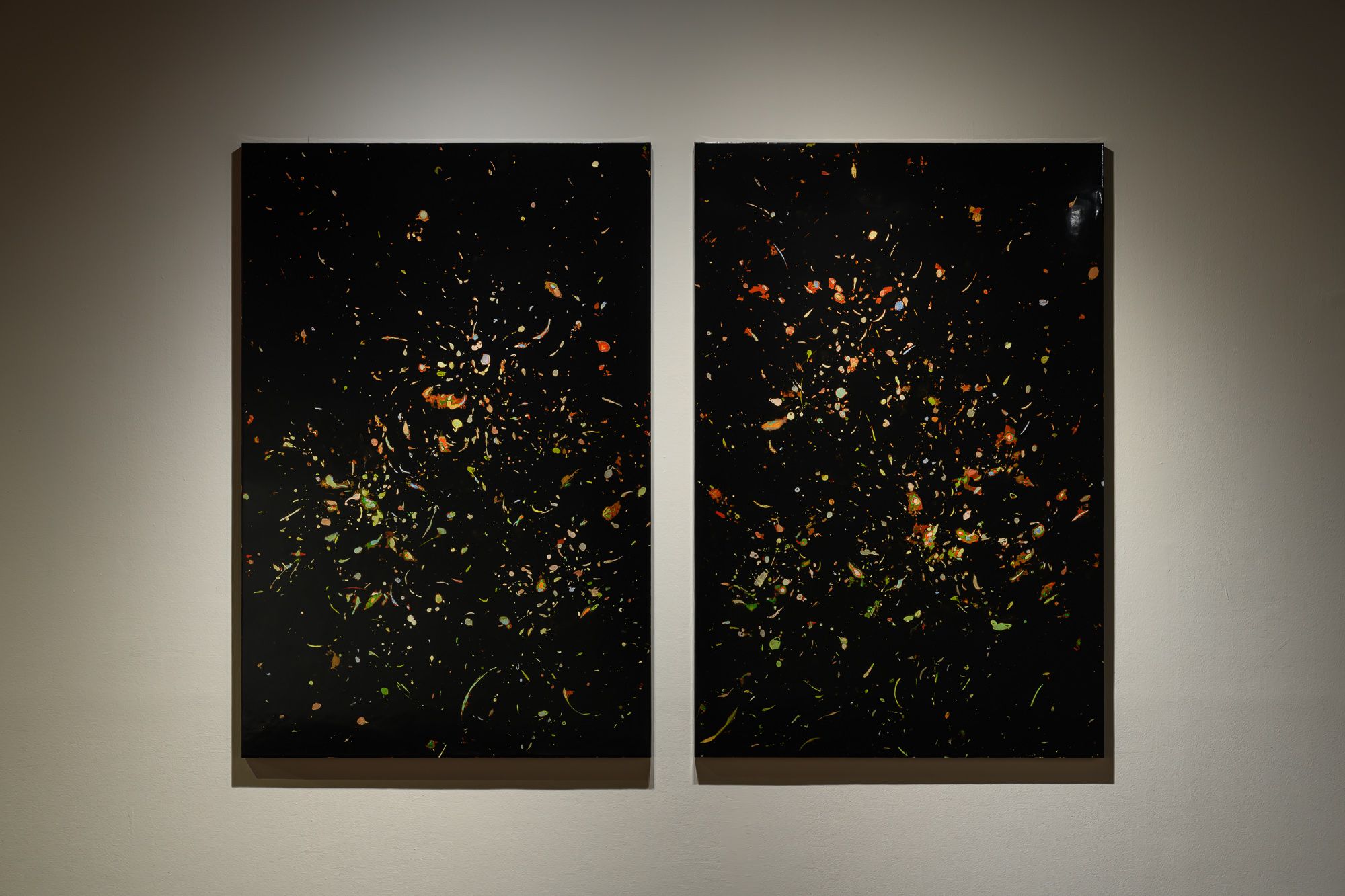
Honorable Mention: Grace Wu, M001, acrylic on canvas, 145.5×97×3.5 cm ×2, 2025. (Photo courtesy of CTBC Foundation for Arts and Culture.)
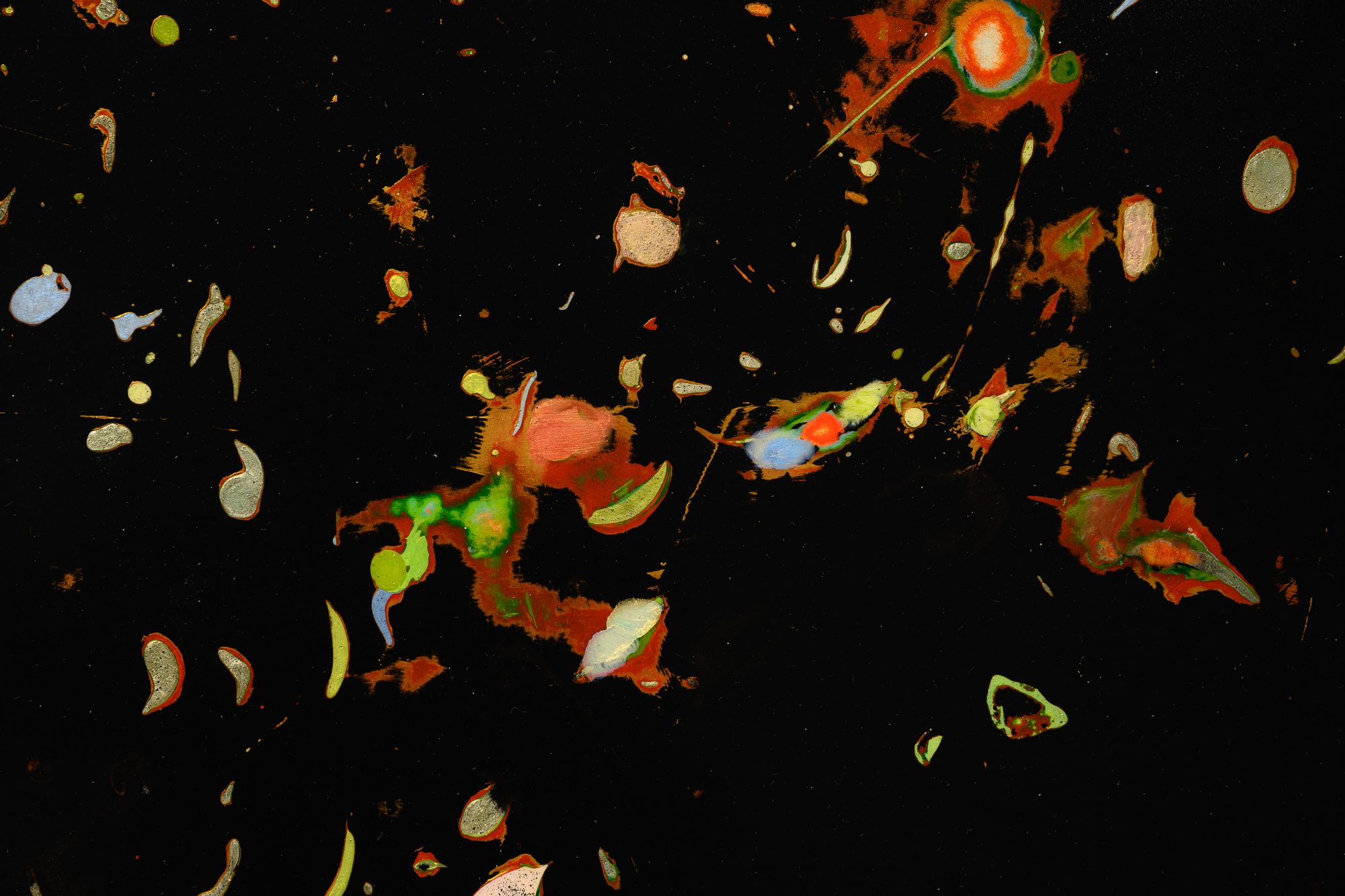
Honorable Mention: Grace Wu, M001 (detail). (Photo courtesy of CTBC Foundation for Arts and Culture.)
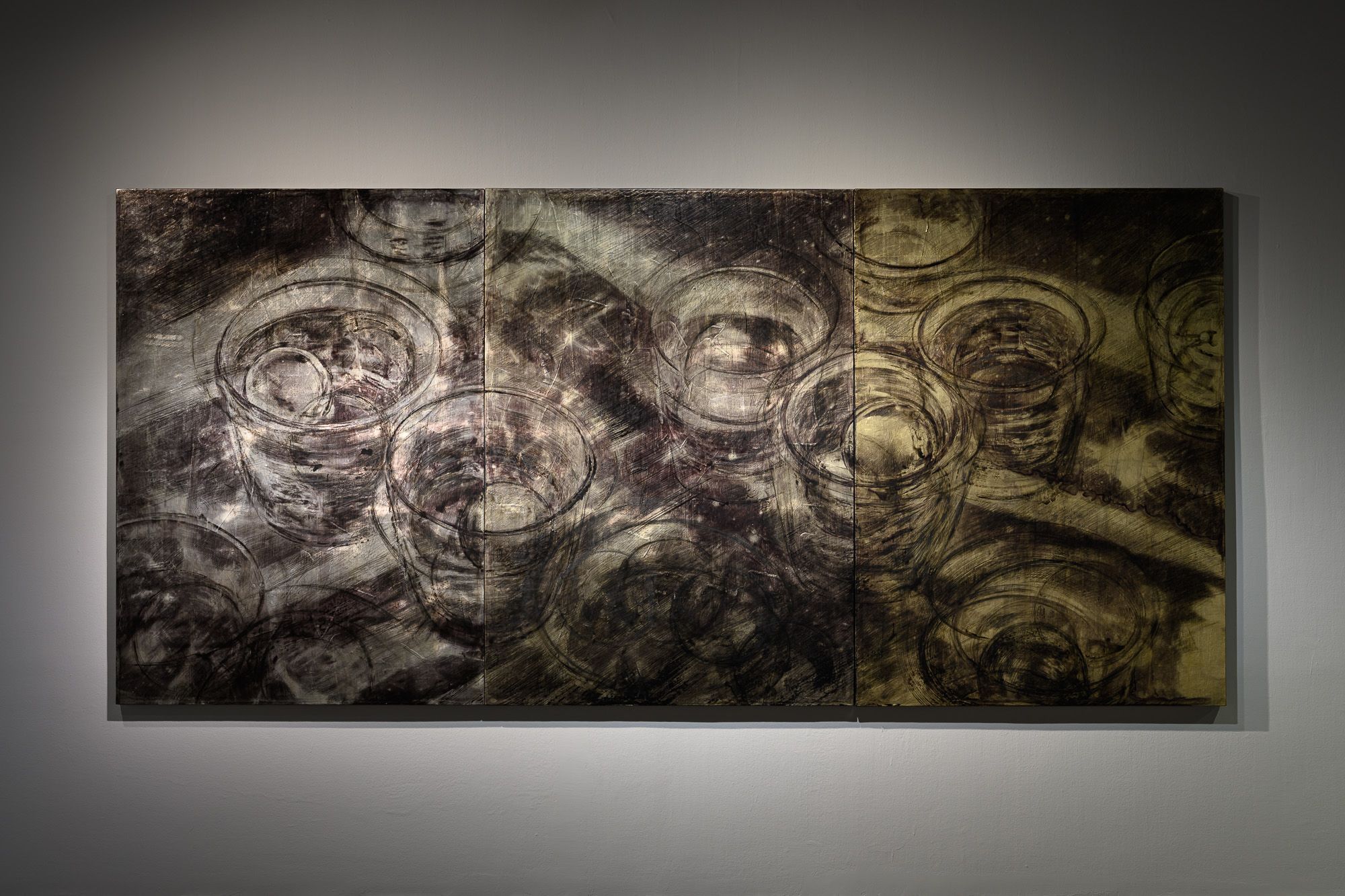
Honorable Mention: Huang Chih-Cheng, Still Life, ink, pigment ink, water-based pigment, silver leaf, Korean Jangji paper, canvas, 136×291×3.5 cm, 2025. (Photo courtesy of CTBC Foundation for Arts and Culture.)
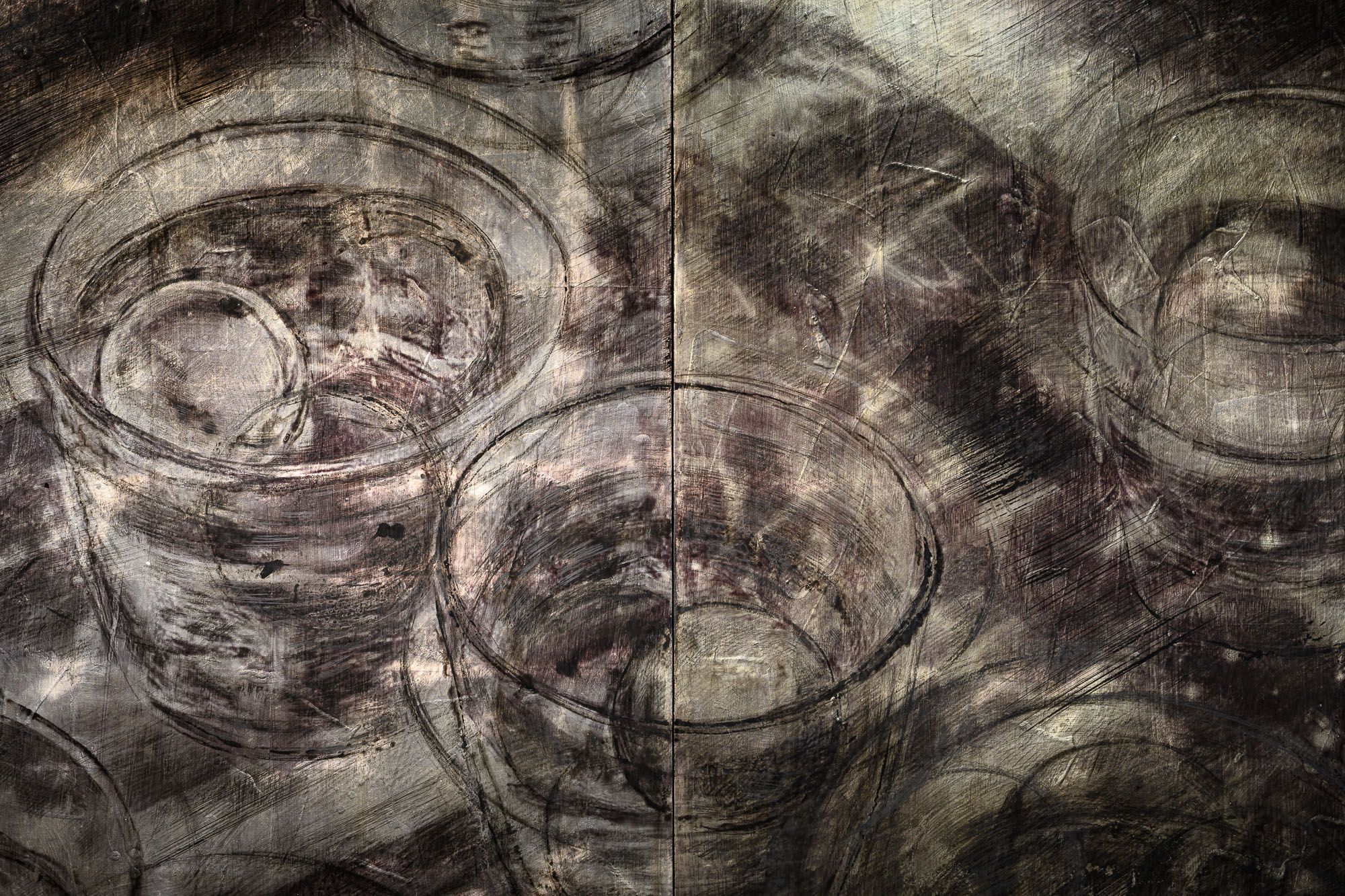
Honorable Mention: Huang Chih-Cheng, Still Life (detail). (Photo courtesy of CTBC Foundation for Arts and Culture.)
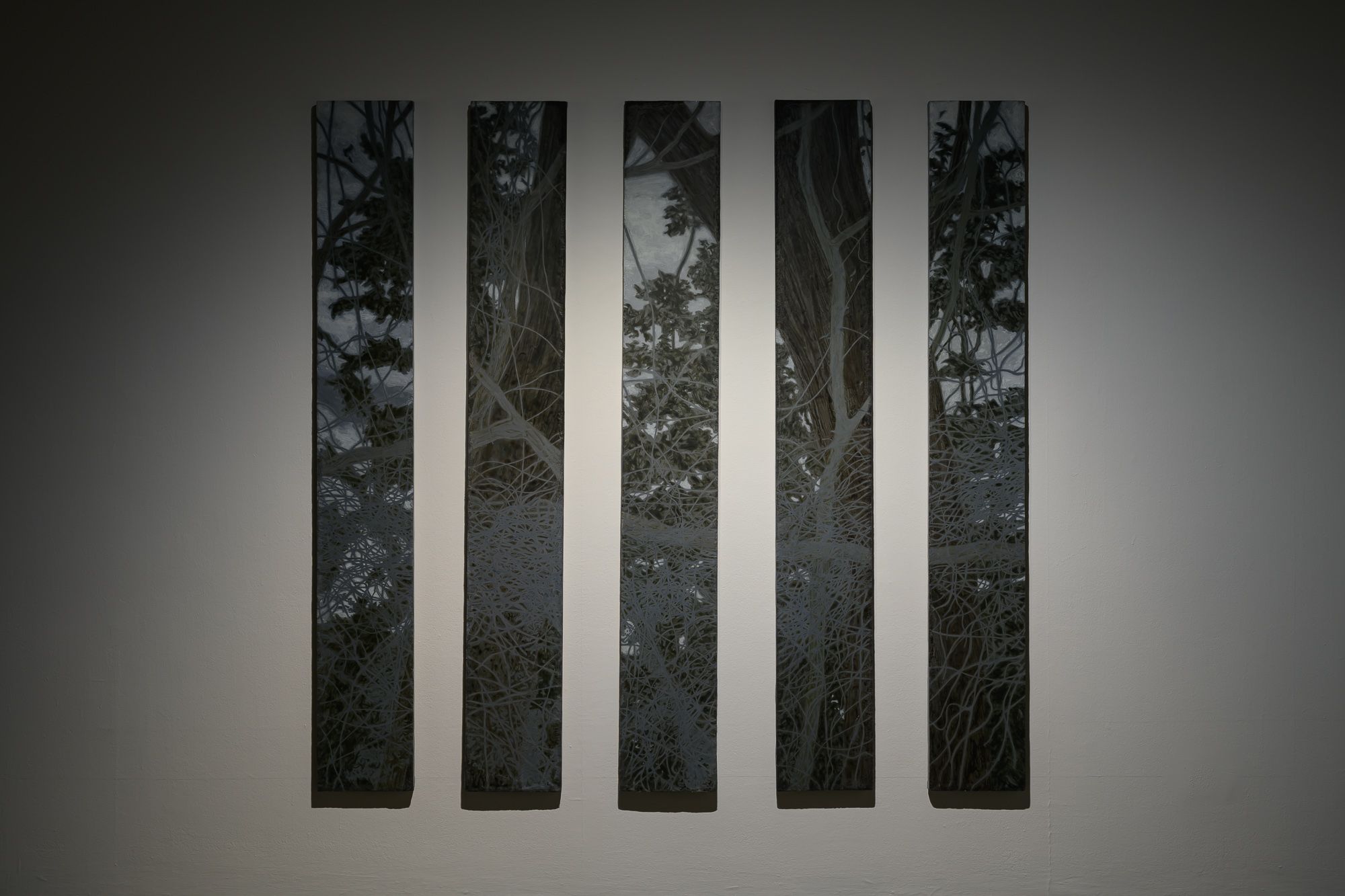
Honorable Mention: Yang Cheng-Yen, Being Stare at Hugely, acrylic, canvas, wool, 180×185×5 cm, 2024. (Photo courtesy of CTBC Foundation for Arts and Culture.)
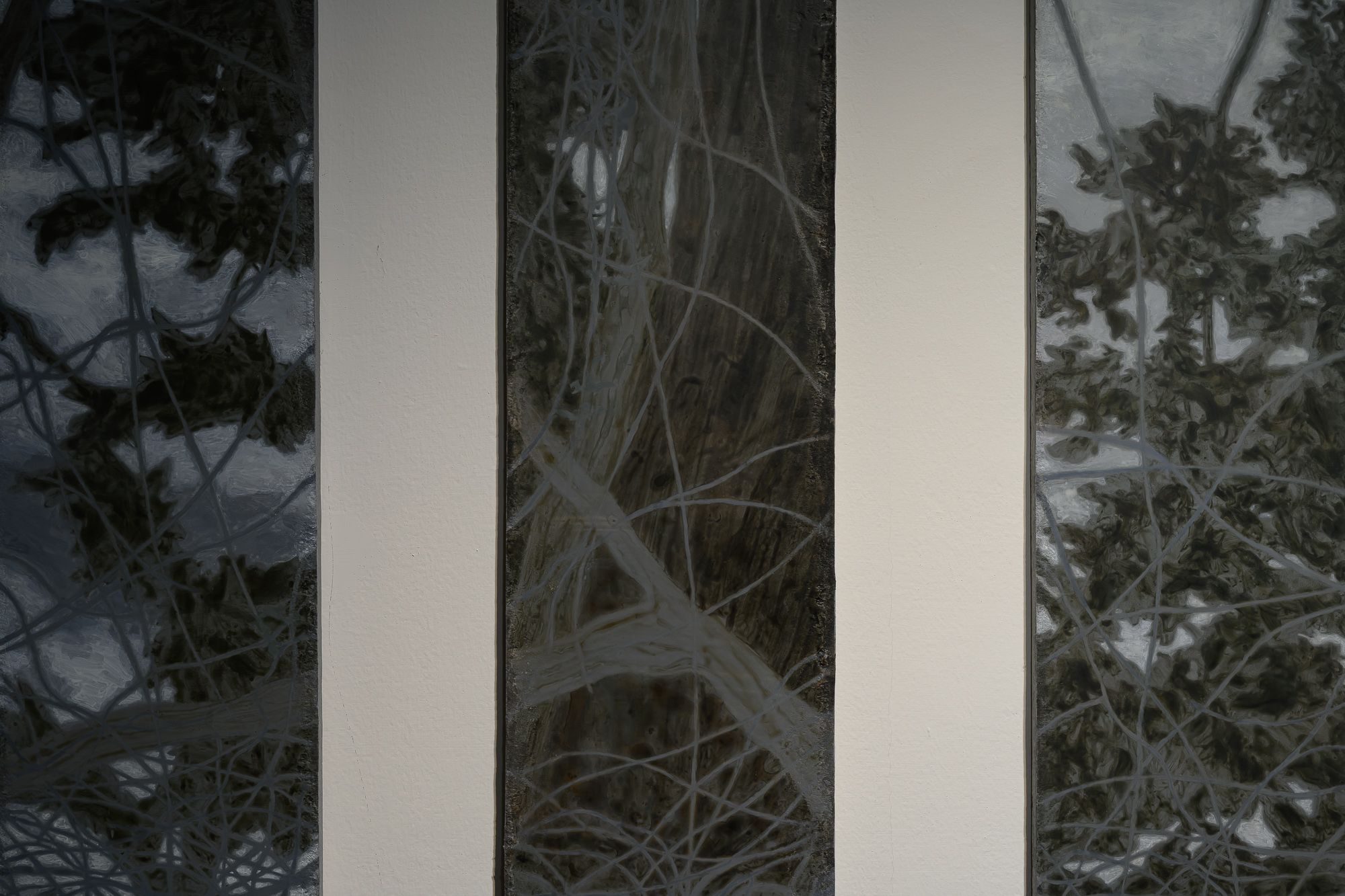
Honorable Mention: Yang Cheng-Yen, Being Stare at Hugely (detail). (Photo courtesy of CTBC Foundation for Arts and Culture.)
For Kuo Ping-En, maintaining humor represents the highest standard of quality. Painting and diverse texts—spanning art history, literature, and philosophy—serve as cues to prompt his own presence. This elegant tension resides in neither uninvolved detachment nor direct, interventionist critique. His work Ophelia No. 619 Green shares a cross-temporal translation with John Everett Millais's 1852 Ophelia. The two arched upper corners of the original masterwork were cropped into 'paintings' by Kuo's curiosity; these hand-drawn 'offcuts' scattered beside the main panel act as the painter's exclusive sticky notes: 'This is my humble, sincere question to the masters of art history.
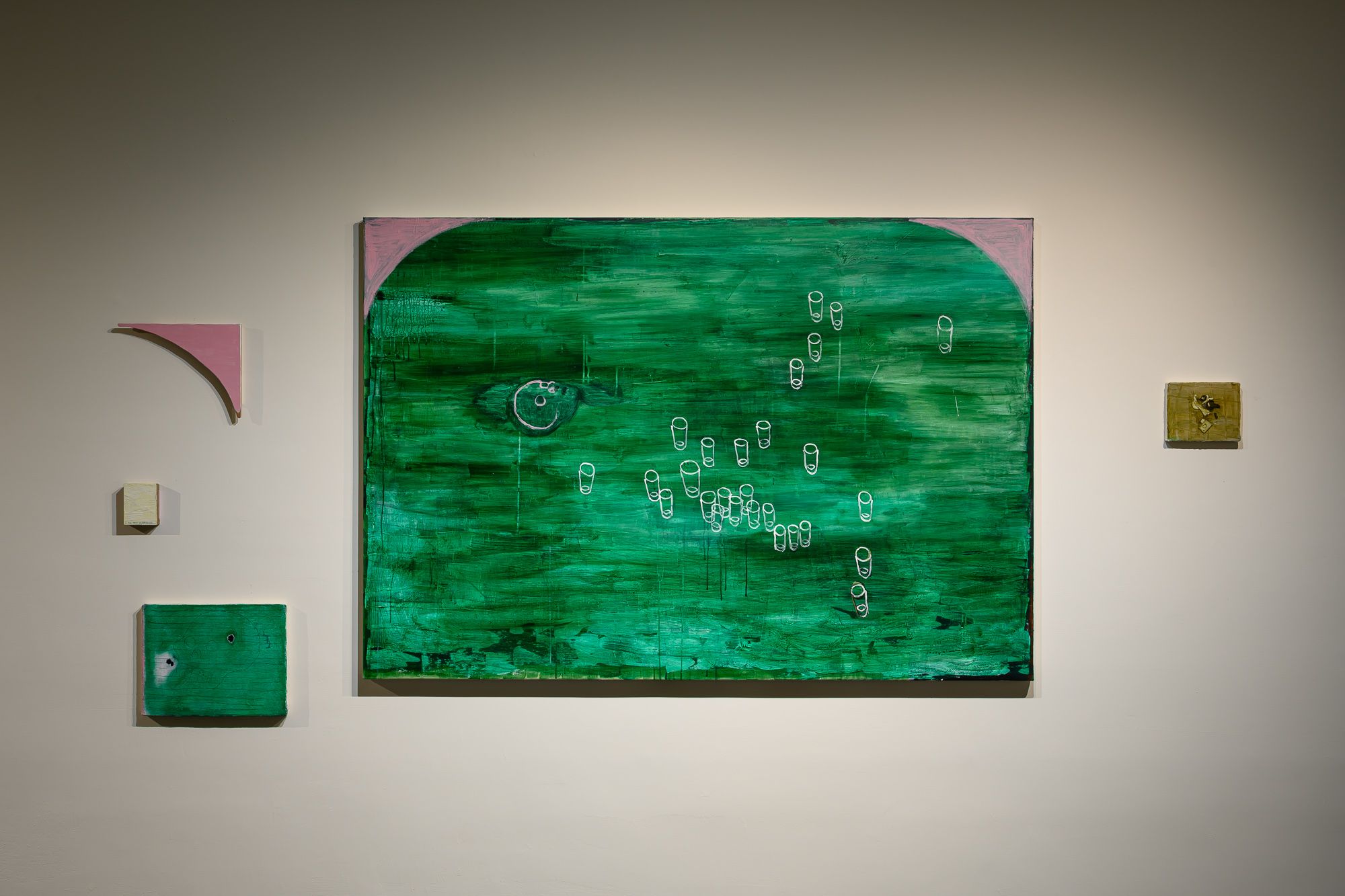
Honorable Mention: Kuo Ping-En, Ophelia No. 619 Green, acrylic, canvas, wood panel, ballpoint pen, 23×30×2.5 cm, 10×8×2.5 cm, 27×35×2 cm, 112×162×3.5 cm, 14×18×2 cm, 2025. (Photo courtesy of CTBC Foundation for Arts and Culture.)
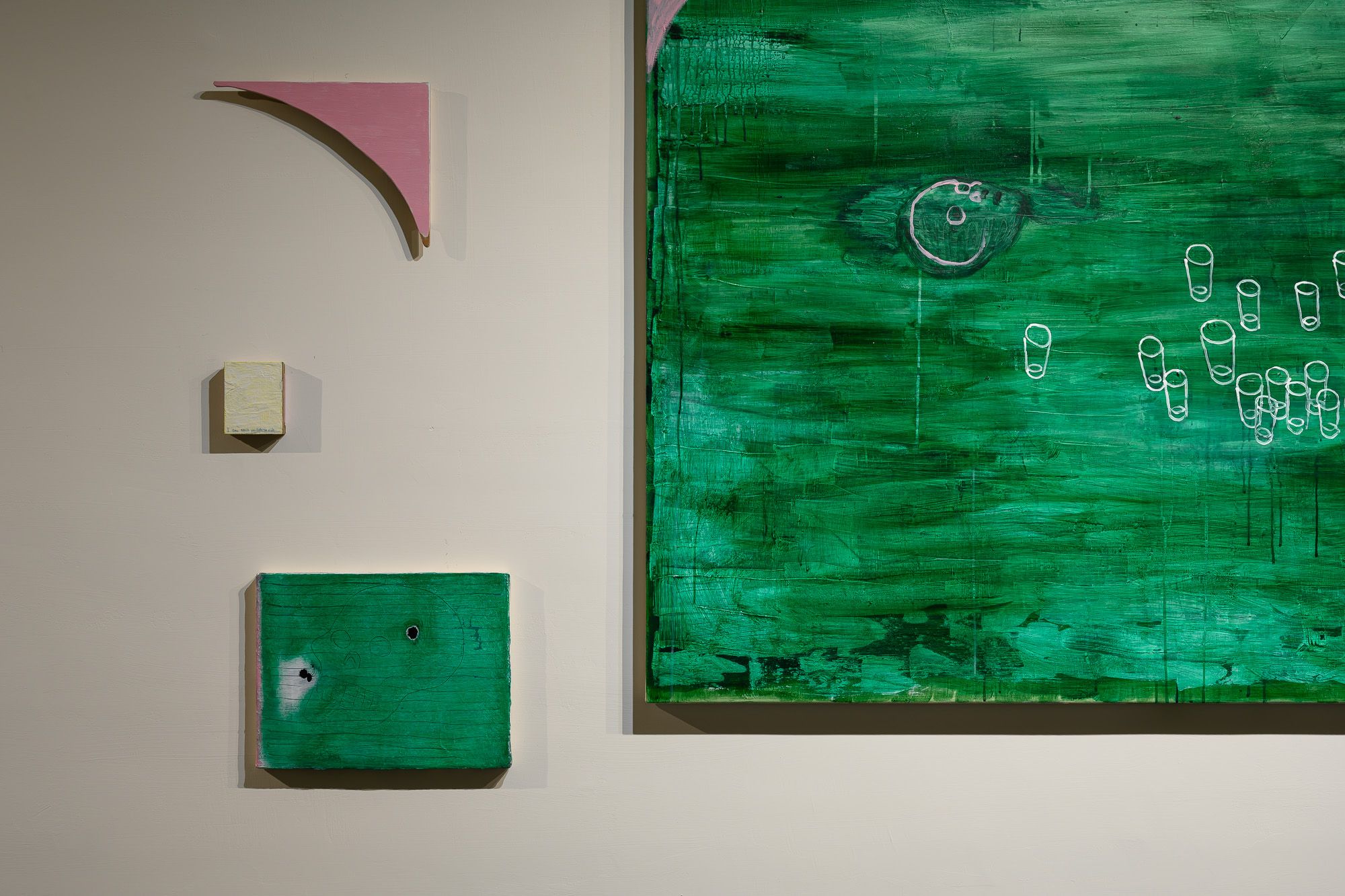
Honorable Mention: Kuo Ping-En, Ophelia No. 619 Green (detail). (Photo courtesy of CTBC Foundation for Arts and Culture.)
The creative methods and postures of these artists are neither uninvolved detachment nor direct intervention; neither pre-packaged emotional posturing nor forced imposition of social events or historical stories. Instead, without forcing meaning, they allow the viewer to maintain a continuous state of seeing.
"Compared to the aforementioned visual arts' indirect handling of the world’s 'surface,' strategies of detour, delay, and non-direct identification have become a contemporary norm. This forces the viewer to engage in reflection and translation before 'comprehending' meaning; within this context, navigating between 'taking a stance' and 'adopting a posture' has imperceptibly become an essential skill in an artist’s nurturing. Conversely, works that exhibit a clear inclination toward taking a stance are rarely simple descriptions; within recognizable forms, they continuously imply multiple references and care for real-world situations.
The tradition of woodcut prints and leftist arts once intervened in reality through strong representational and political mobilization functions—how can contemporary painting make use of this tradition? Lee Tek-Khean’s intense concern for reality is generated precisely within this translation, pulling painting’s habitual 'otherworldliness' back into the real world. In Show Time Trilogy, copper leaf shines inside the worked grooves of woodcuts—glitz and glamour, or is silence golden? 'Allegory' makes one re-aware of the close yet non-reducible historical relationship between woodcut prints and political propaganda; the immense scale amplifies the image's visual impact, while a nearly theatrical viewing experience expands the language of printmaking.
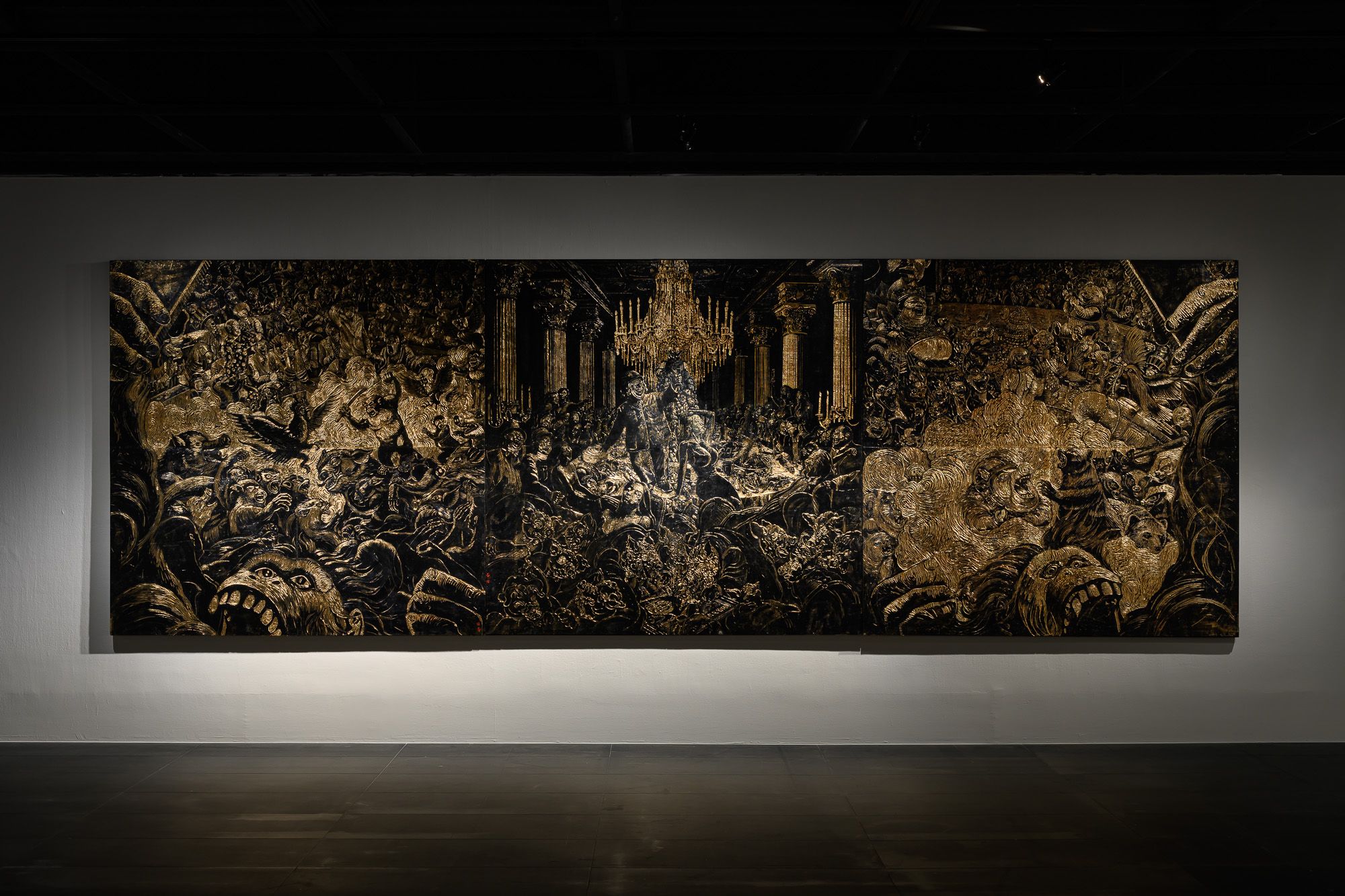
Honorable Mention: Lee Tek-Khean, Show Time Trilogy, wood panel, oil, copper leaf, 183×549×0.7 cm, 2025. (Photo courtesy of CTBC Foundation for Arts and Culture.)
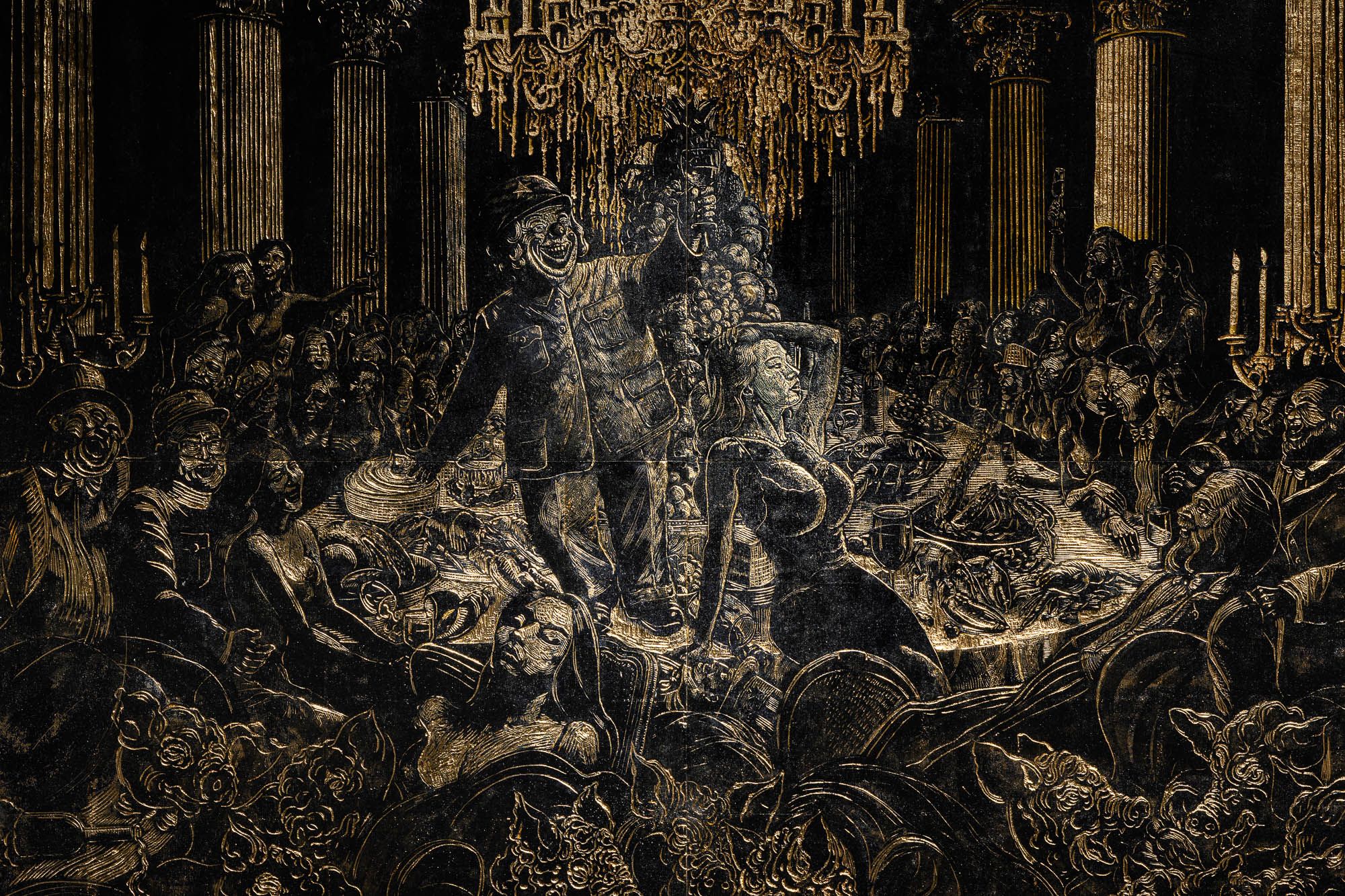
Honorable Mention: Lee Tek-Khean, Show Time Trilogy (detail). (Photo courtesy of CTBC Foundation for Arts and Culture.)
Finally, the works of Chou Kai-Lun and Lin Ying-Hsiu are the two sets that lingered in my heart the longest after viewing the exhibition. This entangling stems not from formal similarity, but from the dialogue opened between their different painting vocabularies: one displays expressive fluidity through color and brushstrokes, while the other forms an almost impressionistic perceptual space within rhythms and layers akin to ink tone. In terms of medium alone, Lin Ying-Hsiu is the only artist in this year's exhibition working with ink; yet even within an ink group exhibition, her work represents a rare 'purification' of black and white. Nothing on the canvas is still; rustling and agitated, carrying a brush intent of subtle tickling and restless impulse (ngiau), or may be seen as a deformation and re-composition of traditional ink techniques: Cun (texture strokes), Cha (rubbing strokes), Dian (dotting), and Ran (washing / dyeing). To me, however, it feels closer to a 'trace landscape'—like a fleeting glance—continuously pursuing the trail of brush intent beyond visual habit.
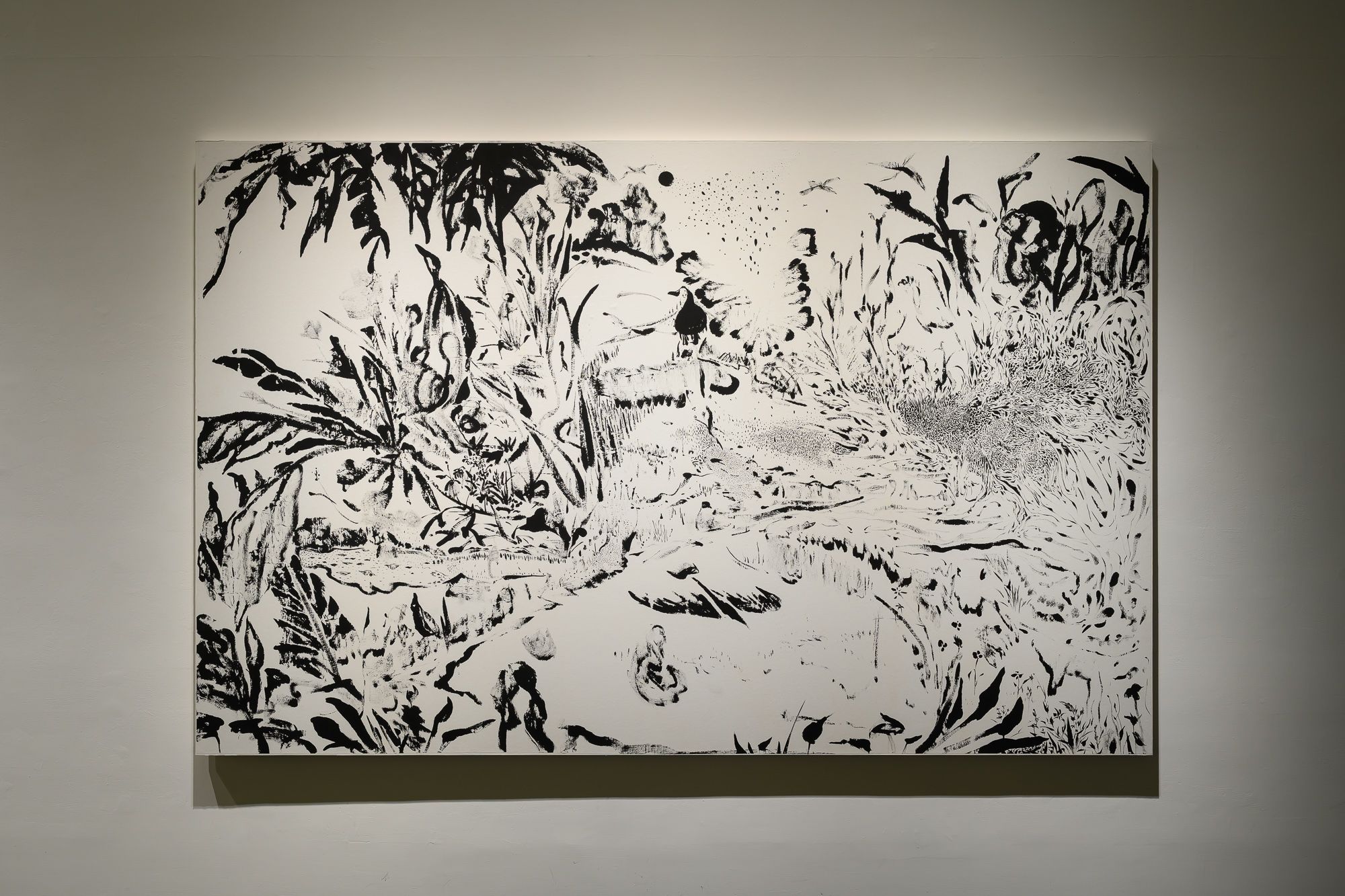
Honorable Mention: Lin Ying-Hsiu, Illusion・Forest, ink and Xuan paper, 191×300×6 cm, 2025. (Photo courtesy of CTBC Foundation for Arts and Culture.)
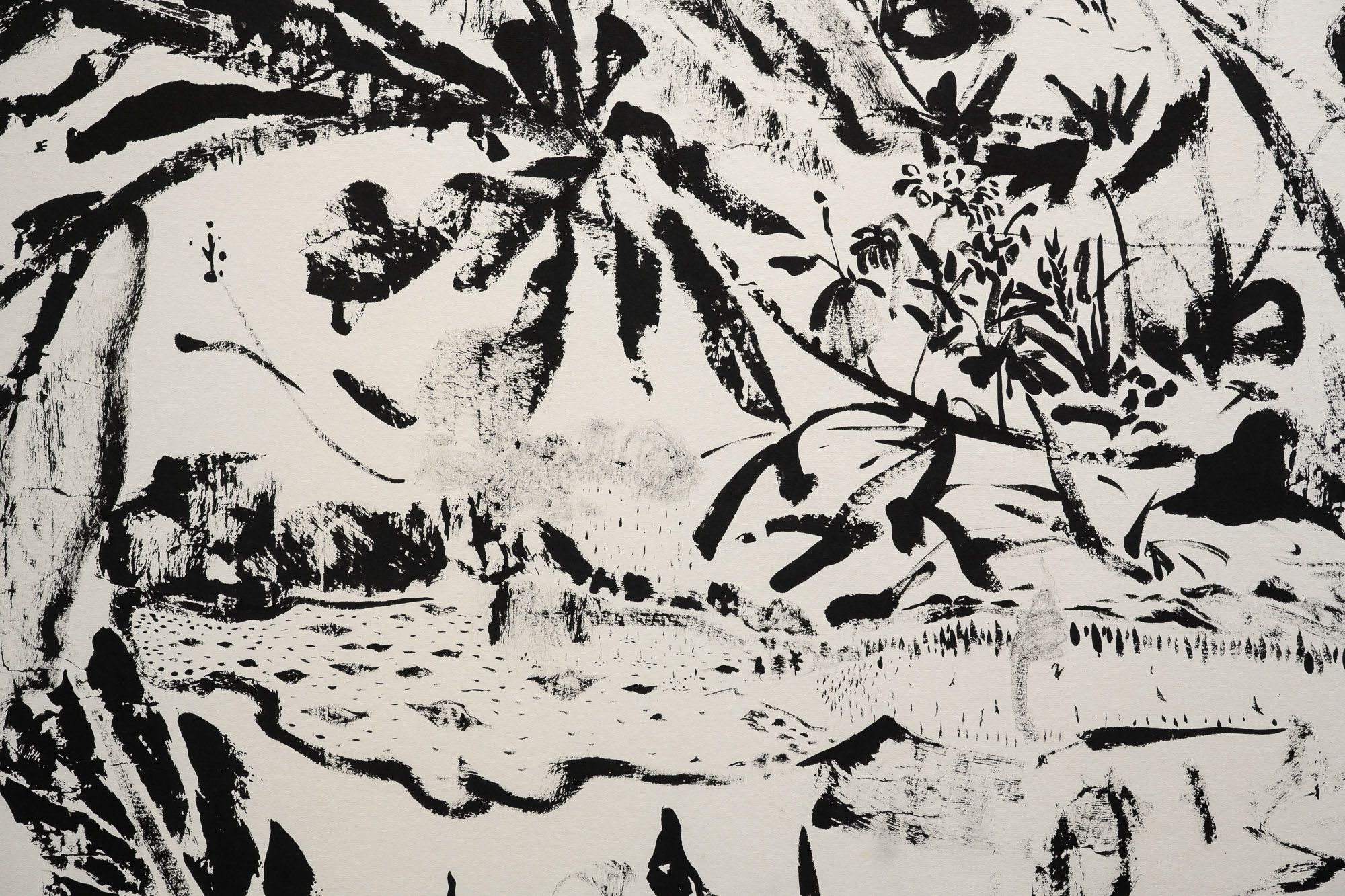
Honorable Mention: Lin Ying-Hsiu, Illusion・Forest (detail). (Photo courtesy of CTBC Foundation for Arts and Culture.)
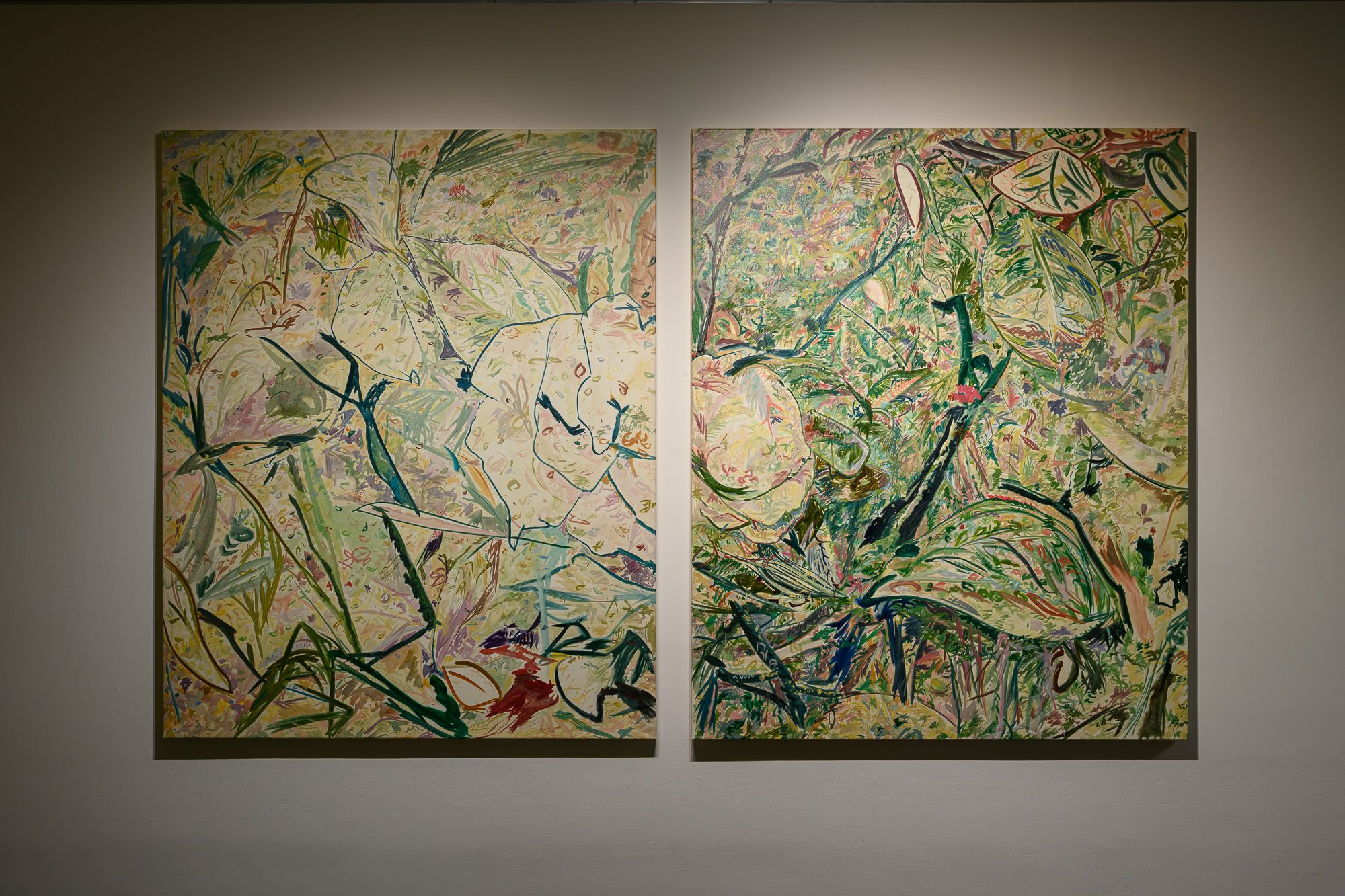
Honorable Mention: Chou Kai-Lun, My Bouquet, oil on canvas, 170×138×3 cm ×2, 2025. (Photo courtesy of CTBC Foundation for Arts and Culture.)
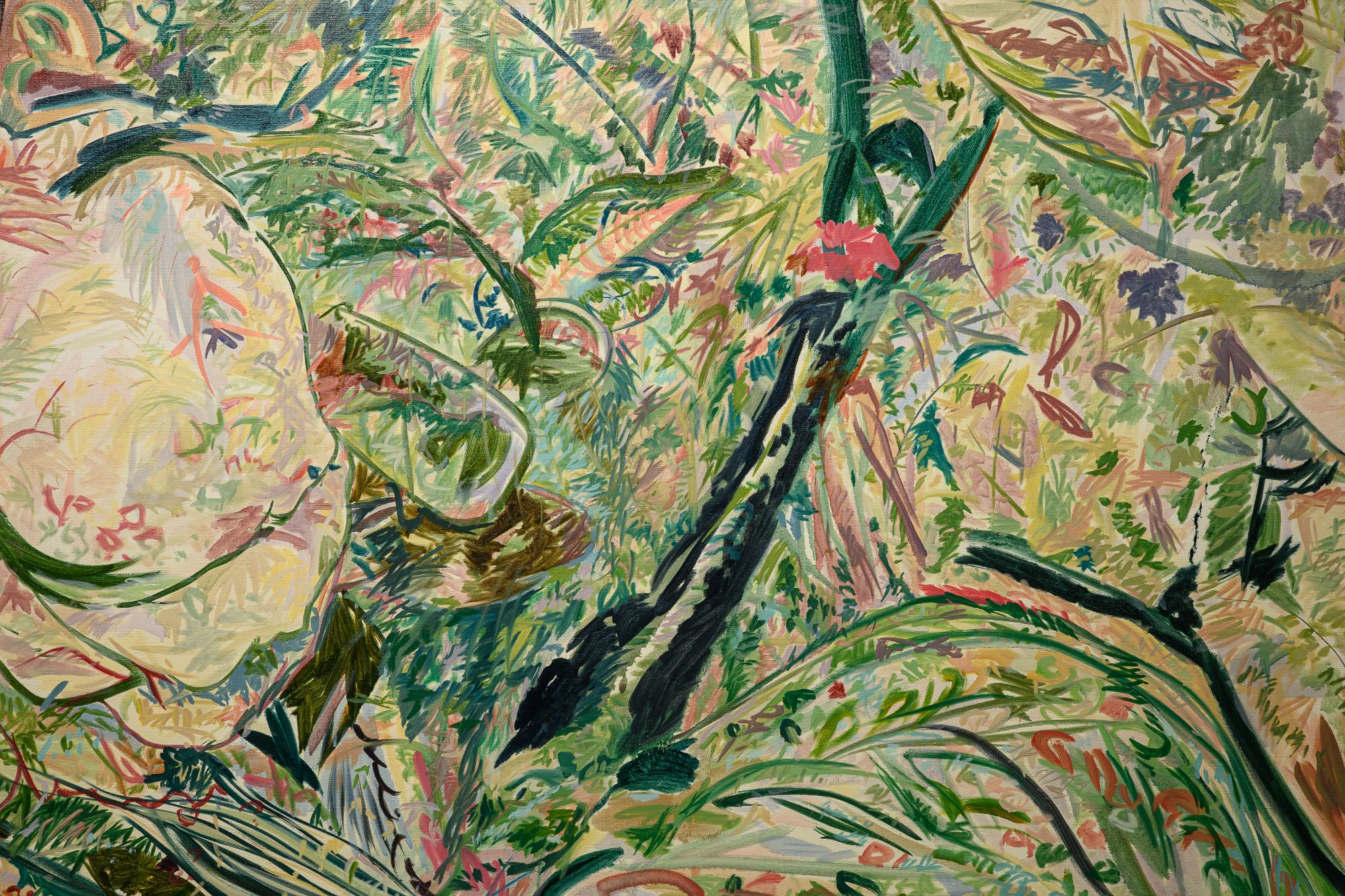
Honorable Mention: Chou Kai-Lun, My Bouquet (detail). (Photo courtesy of CTBC Foundation for Arts and Culture.)
It is precisely during this process of pursuit that the image is not pre-constructed, but inadvertently generated while searching; this is both an adventure in creative methodology and a continuous testing of established paths in ink art.
In contemplating Chou Kai-Lun’s work, a thought flashed through my mind: ‘If Wang Meng had the chance to gaze at Mont Sainte-Victoire alongside Cézanne, would he have painted it like this?’ My Bouquet uses swift, nimble, rhythmic stippling and line strokes to weave intricate, winding tones. Gorgeous grays allow viewers to discover a bouquet amid pure woodland light and shadow—visible from afar, yet deeply engaging upon close inspection.
An artist’s profound uniqueness—akin to rare flora within an art ecosystem—remains the core value that various awards seek to discover and identify. The jurors' back-and-forth tug-of-war represents a quest for dynamic balance amid diverse creations, while artists, revealing distinct styles and postures, radiate radically different painting dimensions and rhetorical languages.
The recognition that 'since Pop Art, numerous subcultures have gradually become creative subject matter for artists' might, in today’s flourishing digital media landscape, be transformed into the idea that every artist inherently exists within multiple subcultural niches simultaneously. What an artwork reflects is not only the artist's path of thinking about art and the relationships they construct, but also a fractionated historiography. Likewise, within contemporary award mechanisms, evaluation criteria manifest a pluralistic and fragmented state. An award’s appraisal of a work at a given moment represents the scale, framework, and mechanism through which a society views art at a specific historical juncture. If conceptual and issue-driven tendencies prevail in contemporary art in Taiwan, they stem from Taiwan's own context and historical factors, configured through each artist's distinct intellectual and psychological disposition. The 'CTBC Painting Prize' serves as both a site where the value of painting is identified and a field where institutions and aesthetics interact. Precisely under this premise, scales, frameworks, and mechanisms operate and temporarily gain legitimacy, shaping a mode of viewing art that is momentarily validated by our times. This validity is 'temporary' because we still harbor expectations of writing history through art—whether those expectations take the form of genuine acclaim or malicious questioning and debate. Those 'interested parties' are never outsiders; they are drivers continually stimulating the environment.
Finally, writing up to this point, even I cannot help but shout to myself: ‘Alright, that's enough (Ça suffit !)! Let's step away from smartphone screens for a moment, come to the exhibition hall properly, and stand before the real original works!’ Gazing at the selections of each edition reveals what changes are unfolding. Original works glow under painters' brushes, sparkle in the exhibition hall, and light up once again in the eyes of viewers.