

Text by Chang Chun-Jung
Images by CTBC Foundation for Arts and Culture
Translated by Chuang Chi-Wei
In the trajectory of contemporary art, painting has frequently been thrust into a precarious position. From the invention of photography and the advent of the age of mechanical reproduction, to today's rapid rise of generative imagery and artificial intelligence, painting seems perpetually called upon at pivotal moments in art history to justify its reason for being.
The Prize winners for the 3rd CTBC Painting Prize (hereafter referred to as the "CTBC Prize"), organized by the CTBC Foundation for Arts and Culture, were recently announced. Out of 632 submissions, 19 works were ultimately selected as finalists and prize winners. Among them, Lee Fang-Yu’s White Ceramic Tiles, Flower, Gap emerged triumphant, claiming the First Prize along with a NT$800,000 award. Meanwhile, three Merit Prizes—each carrying a NT$400,000 award—were bestowed upon Chang Hao-Yu’s Beginning with Water… Then a Simulated Narrative, Huang Kuan-Chun’s Space of Presence and Absence, and Huang Chia-Ning’s Cactus Segment (Monkey Tail Cactus).
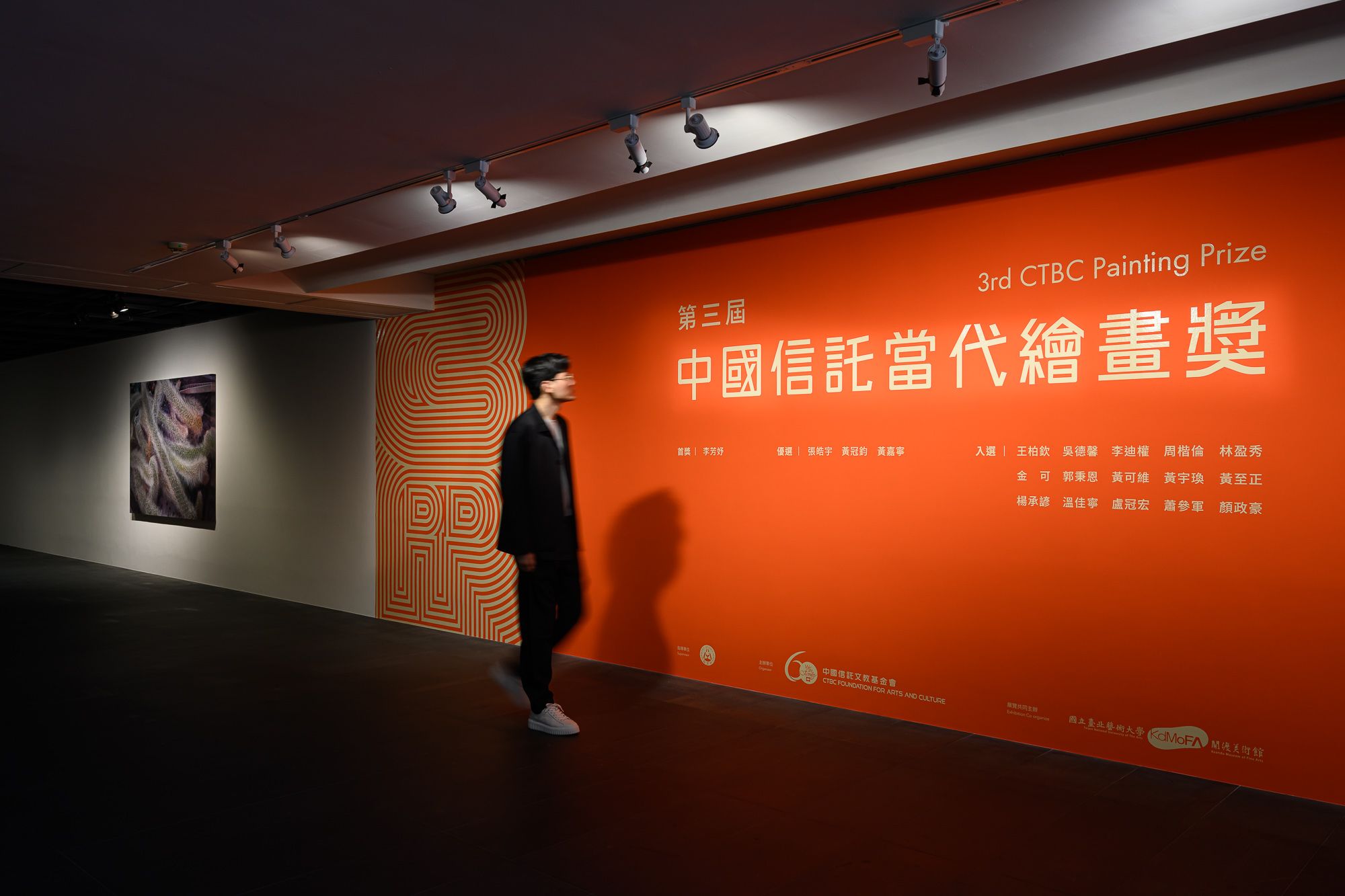
The 3rd CTBC Painting Prize Exhibition is on view at Kuandu Museum of Fine Arts from March 13 through June 14. (Photo courtesy of CTBC Foundation for Arts and Culture.)
A look back at the winning works of the 2nd CTBC Painting Prize reveals a core focus on how 'painting'—as an ancient art form—undergoes contemporary translation, demonstrating how artists forge new creative paths through the hybridity of media and visual language. Two years on, the selected entries for this edition exhibit a noticeably more open, diverse, and rich landscape across scale, medium, and form, with their thematic focus advancing accordingly.
Reflecting on the jury's process, Lin Ping, Jury Chair of the Jury Panel, noted that after multiple rounds of intense discussion and debate, the selected artists ultimately stood out not because they provided definitive answers to the question "What is painting?", but precisely because they approached the very same query through strikingly different creative lenses: within the contemporary context, what new possibilities can painting still unlock?
The overall body of shortlisted works for this edition shows several distinctly defined characteristics. Compared to past editions, creations that directly engage with macro-social issues are rare. Instead, many artists have pivoted back to daily experiences closer to themselves, rethinking the relationship between painting, the self, history, and society.
The First Prize-winning work, Lee Fang-Yu’s White Ceramic Tiles, Flower, Gap, originated from a private and everyday moment: while moving houses, the artist suddenly took notice of the white ceramic tiles commonly seen in Taiwanese residences. Using nine tiles as a single unit, Lee painted tulips, eyes, noses, and mouths onto the white tiles, which were then dismantled and reassembled into an installation spanning 14 meters in length. This colossal scale creates a potent visual tension, while using the ordinary tiles beneath our daily feet as a canvas injects a sense of humor and liberated playfulness.
It functions as a magnified fragment of everyday life, where personal memory and material order intersect. Clean, orderly, and easily sanitized, the white tiles subtly harbor an almost imperceptible sense of regimentation. In response, the artist chooses to cover, disrupt, and modify these pre-existing rules through layers of paint and imagery. In doing so, she unexpectedly enjoyed the various troubles brought by creating a monumental scale, avoiding the repetition of practice-bred mastery to once again feel the inherent challenges and instabilities of the process.
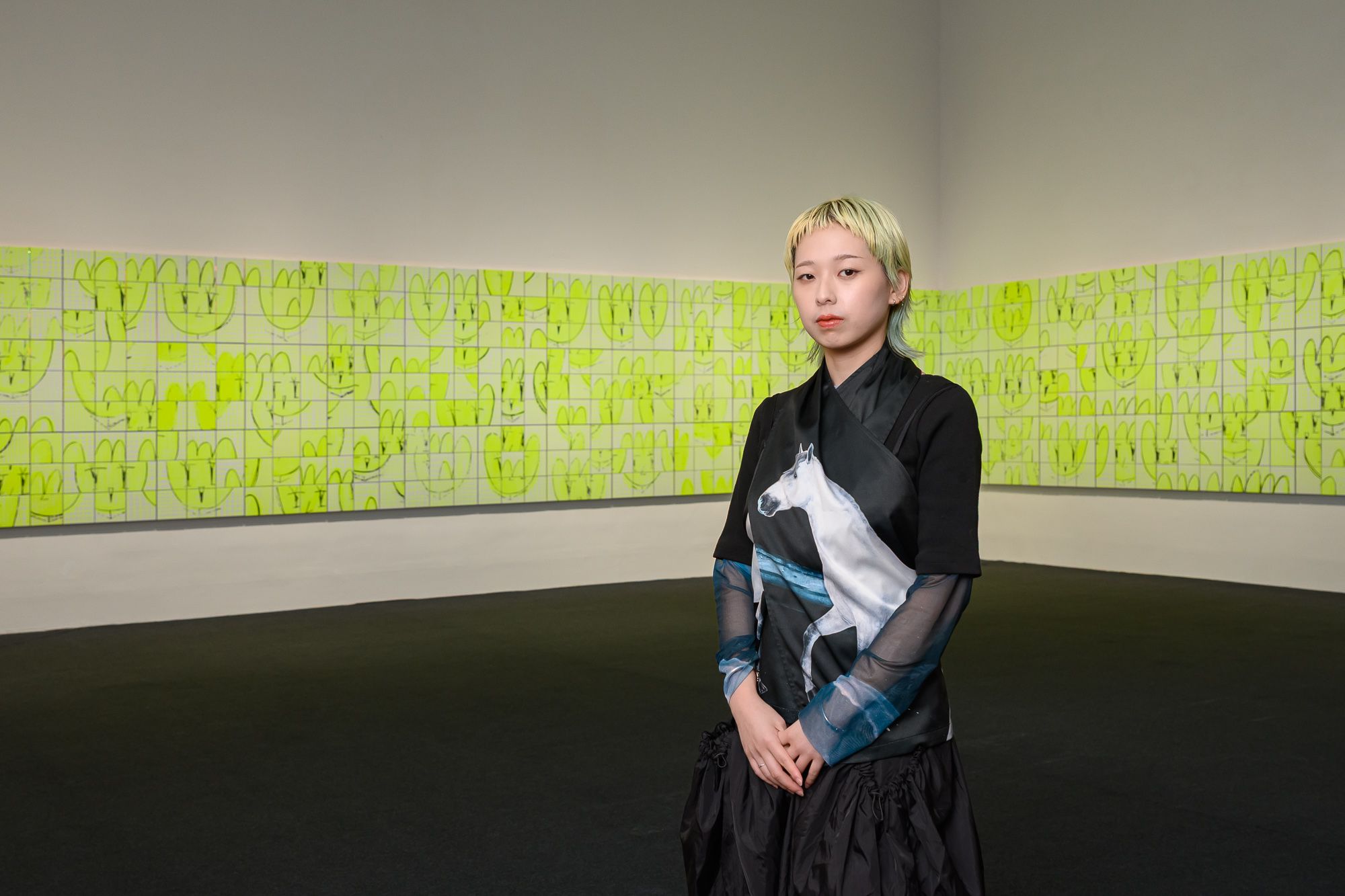
First Prize artist Lee Fang-Yu wins the NT$800,000 award with White Ceramic Tiles, Flower, Gap. (Photo courtesy of CTBC Foundation for Arts and Culture.)
Based on long-term observations of art education and creative practice, Lin Ping also notes that despite recurrent proclamations that "painting is dead," the volume of submissions to the art prize reveals that Taiwan maintains a vast and highly active community of painters. This prompts further reflection: as emerging technologies continually reshape our ways of seeing, what drives the "painting impulse" of the generation of artists shaped by the image era? And how do they respond to contemporary visual experiences and issues through the hybridity of medium and form?
The Merit Prize-winning work, Beginning with Water… Then a Simulated Narrative, departs from a distinctly 'contemporary' perplexity. After previously employing AI-generated imagery as raw material for painting, Chang Hao-Yu gradually experienced a sense of agency lack. Caught between ‘painting realistically’ and ‘what constitutes creation,’ he re-examined what he ought to paint. Consequently, this work directly lays bare upon the canvas a state that is 'still under construction, as yet unfinished.'"
The artist intentionally retains a sense of 'temporality,’ unfolding from the fluid and unsettled nature of ‘water’ to mirror a state where imagery is in a constant state of generation and flux. Through charcoal sketches embedded along the edges and marks left by repeated layerings and revisions of oil paint, the work exposes how a painting comes into being through an ongoing sequence of choices, hesitations, and edits. In contrast, Wang Po-Chin’s New System Sample 6: How to Cut Milk draws from meme images recommended by social media algorithms, transposing them onto canvas via crayon and acrylic. Through the tactile marks, layering, and blurring of manual labor, the piece responds directly to the rapid, instant nature of image generation.
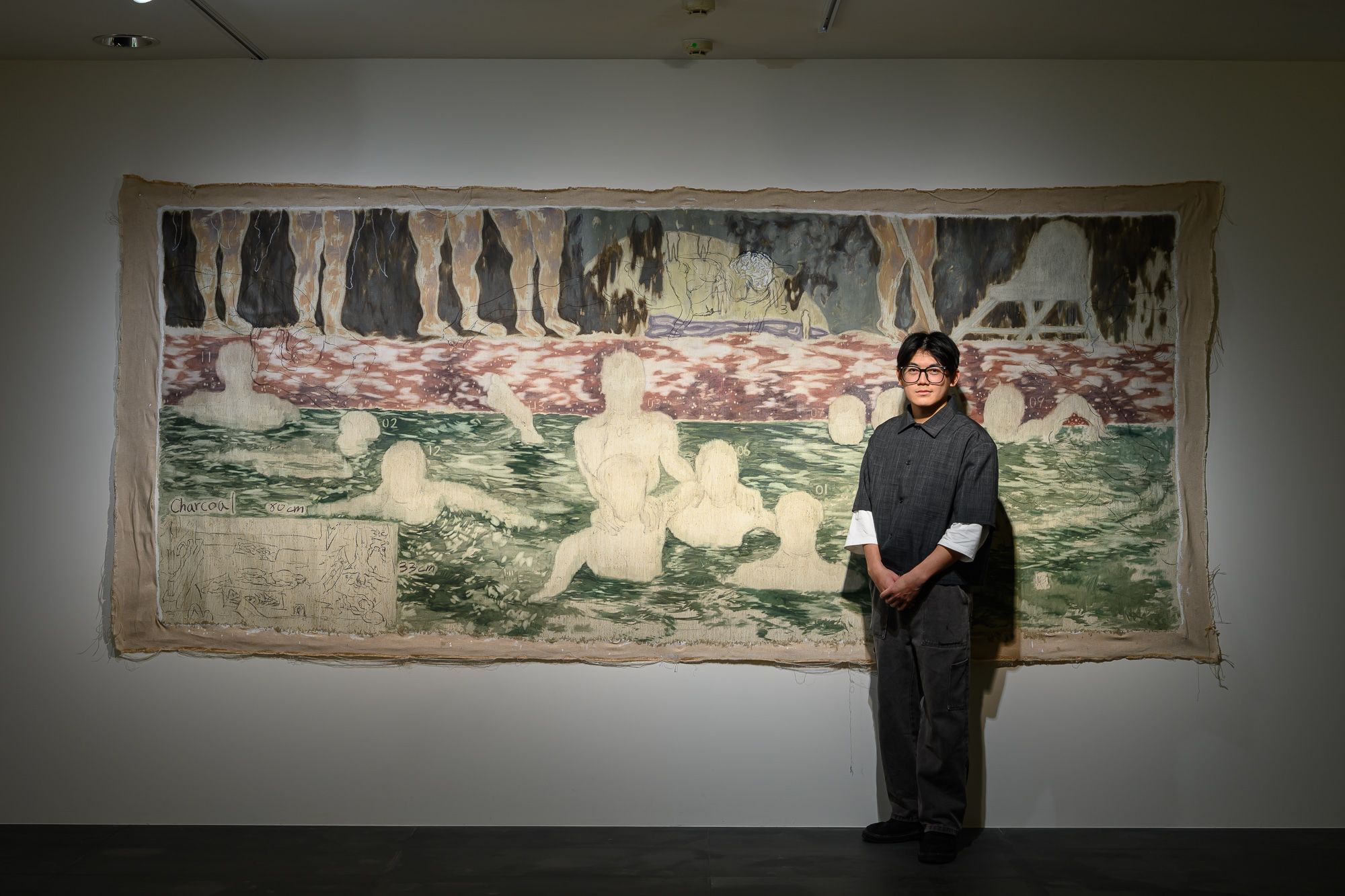
Merit Prize artist Chang Hao-Yu wins the NT$400,000 award with Beginning with Water… Then a Simulated Narrative. (Photo courtesy of CTBC Foundation for Arts and Culture.)
If the previous two works focus on the speed and process of image generation, Huang Kuan-Chun moves a step further back to the ‘materiality’ of the medium itself.
Inspired by the chance play of light and shadow falling on architectural walls in daily life, he turned to contemplate the relationship between paint, light, and support platforms. For his series Space of Presence and Absence, involves brushing layers of acrylic paint onto glass platforms, allowing them to dry before peeling them off to form translucent layers permeable by light. From a distance, the work resembles a wash of color across a white canvas; only upon closer inspection does one realize the entire piece is woven from the interplay of pigment, light, and shadow suspended over transparent glass.
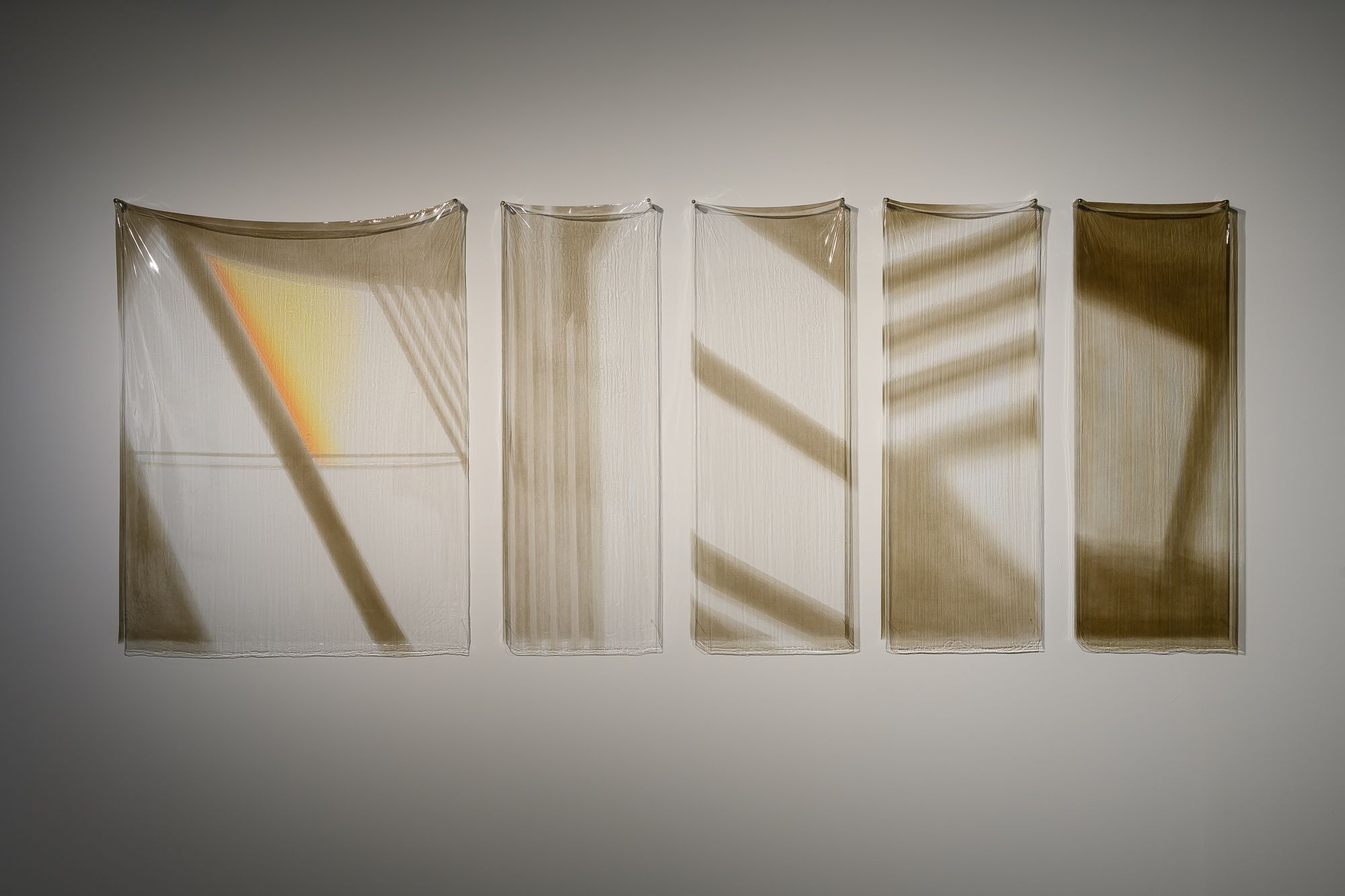
Merit Prize winner Huang Kuan-Chun's Space of Presence and Absence, 108×264×6cm, acrylic ink, acrylic medium, 2025. (Photo courtesy of CTBC Foundation for Arts and Culture.)
While differing in form, they subtly forge a collective tendency in their critical reflection on 'how to view a painting'—it no longer points solely to traditional brushwork or techniques, but shifts toward intervening in the act of viewing itself. Against a backdrop of oversaturated imagery, painting no longer competes with imagery for clarity or representational capacity. Instead, it turns to address the perceptive conditions that images fail to fully capture: hesitation, displacement, and sensory discrepancy. As reflected in recent international painting trends, an increasing number of artists employ blurring, afterimages, distortion, or a dreamlike logic to 'slow down' or even 'disrupt' the process of viewing.
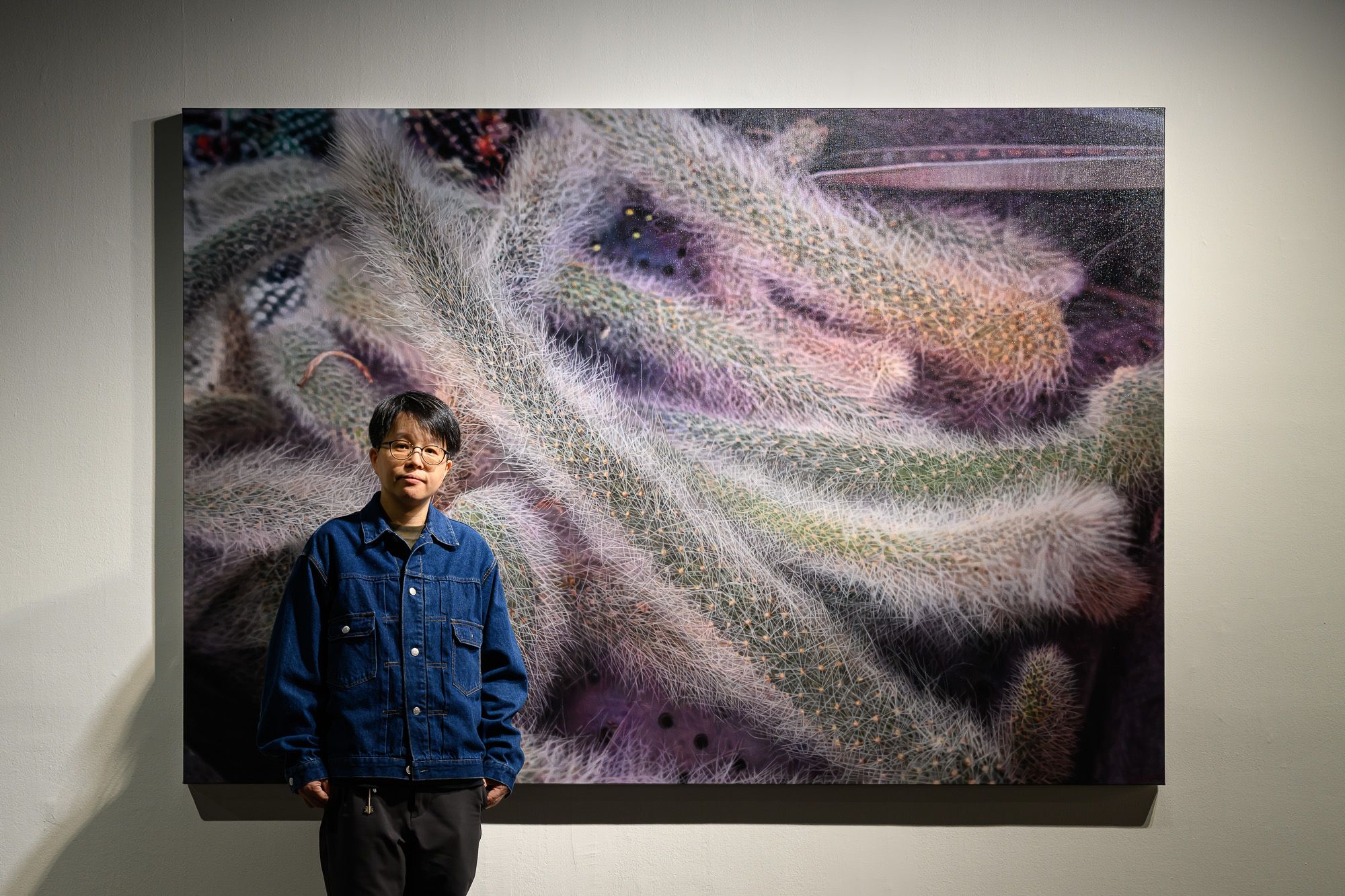
Merit Prize recipient Huang Chia-Ning was awarded NT$400,000 for her work, Cactus Segment (Monkey Tail Cactus). (Photo courtesy of CTBC Foundation for Arts and Culture.)
Huang Chia-Ning’s Cactus Segment (Monkey Tail Cactus) likewise stems from an everyday experience. The discrepancy between the cactus’s plush, velvety exterior and the sharp prick of its spines piercing the skin is translated into another layer of visual dislocation within the picture plane—an image as realistic as a photograph that nevertheless remains, in essence, a painting. This conversion from bodily perception to medium unsettles the 'reality' to which painting points: visual verisimilitude and perceptual rupture coexist, suspended between sensation and representation. In Huang Chih-Cheng’s Still Life, the uncertainty of viewing emanates directly from the materiality of the medium itself. Using three subtly distinct shades of dyed silver leaf as a substrate, the artist captures the refracted light and shadow of a single glass tumbler under varying conditions. The parallax created by these minute variations yields a visual condition akin to a digital glitch.
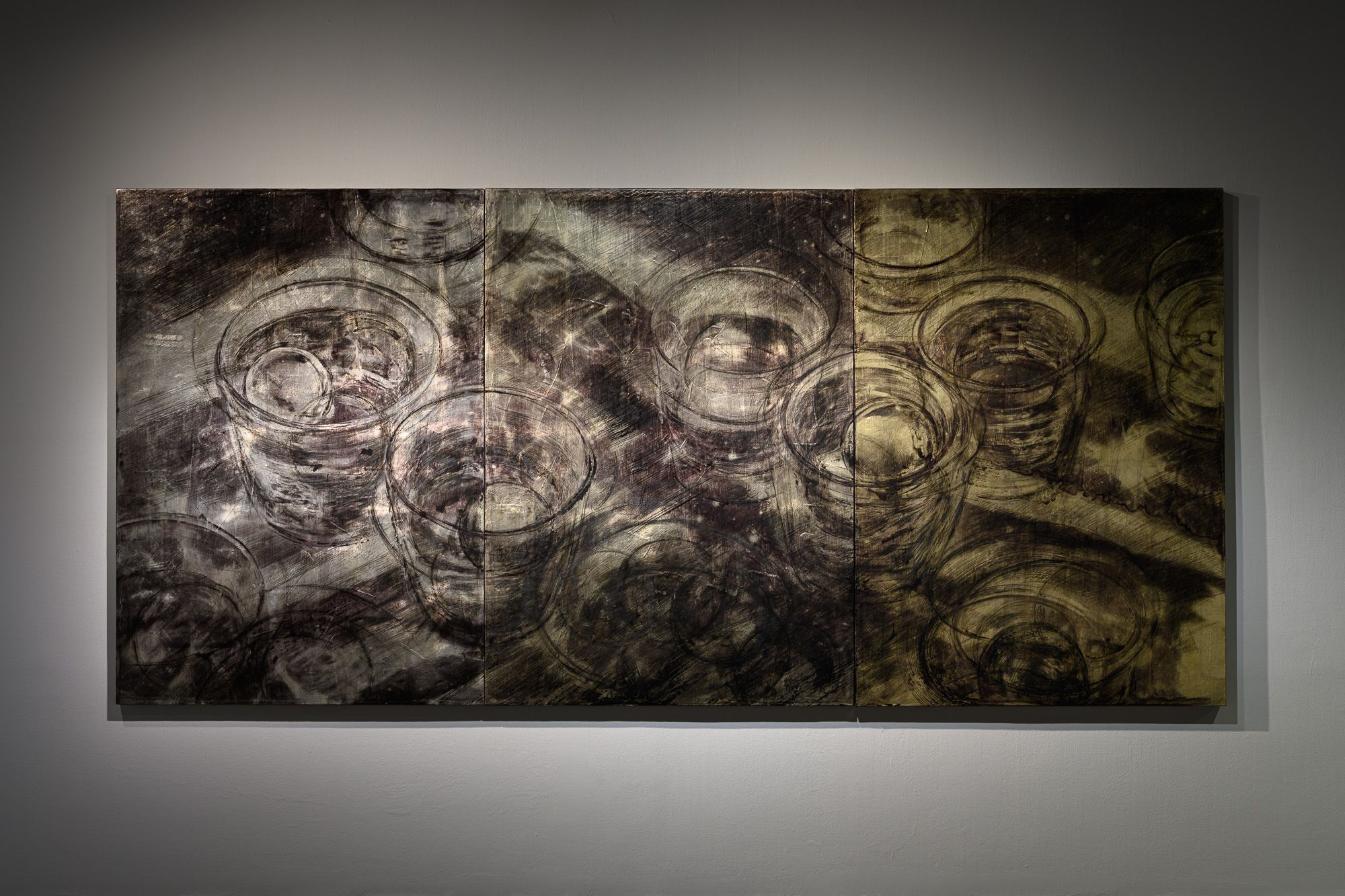
Honorable Mention Huang Chih-Cheng's Still Life, 136×291×3.5cm, ink, pigment ink, water-based pigment, silver leaf, Korean Jangji paper, canvas, 2025. (Photo courtesy of CTBC Foundation for Arts and Culture.)
As a prize explicitly centered on ‘contemporary painting,’ the CTBC Painting Prize provides a support system capable of evolving with the times to rethink and debate the meaning of ‘painting.’ As evident in the robust volume of submissions each year—and as Lin Ping remarked on site during judging—it is less that ‘the prize validates the artists,’ and more that the overall art ecosystem, to a certain extent, validates the existence of this prize.’
Surveying today’s field of creative practice, despite periodic platitudes proclaiming that 'painting is dead,' artists continuously pick up the medium anew to reframe their understanding of it. Embedded within material, time, and bodily labor, this seemingly ancient medium retains an irreplaceable sense of creative freedom—compelling artists to persistently seek new possibilities within its fold. Though it inevitably faces doubts and challenges along the way, painting never truly vanishes, testifying precisely to the enduring bond between the medium and its makers. Viewed from this perspective, painting need not constantly chase ‘universal, definitive answers.’