

Text by Elanor Wang
Translated by Chuang Chi-Wei
The other day, I happened to sit in front of a canvas, holding a palette of acrylic paints, my mind tangled in a web of thoughts, unsure where to make the first stroke. Flashbacks swept through my head—the days spent drawing and ink-painting at the art studio during my childhood. The sharp contours of plaster casts, bottled flowers, fruit, and the lingering humid air after rain under a Japanese-style veranda all whirled in my mind, yet I remained unable to decide what to paint.
This sense of hesitation resurfaced suddenly as I viewed the honorable mentions of the 3rd CTBC Painting Prize. I couldn't help but wonder: when artists lay down their very first mark, where do they begin? And how do they decide to stop just there, withholding any further strokes?
Organized by the CTBC Foundation for Arts and Culture, the CTBC Painting Prize is a biennial open call for young Taiwanese artists, accepting any work that wholly or partially utilizes painting mediums. Beyond the awards, the final shortlisted works are presented to the public in a group exhibition; this year, the exhibition features the creations of nineteen artists at the Kuandu Museum of Fine Arts on the campus of Taipei National University of the Arts.
As a viewer, where should I begin reading painting?
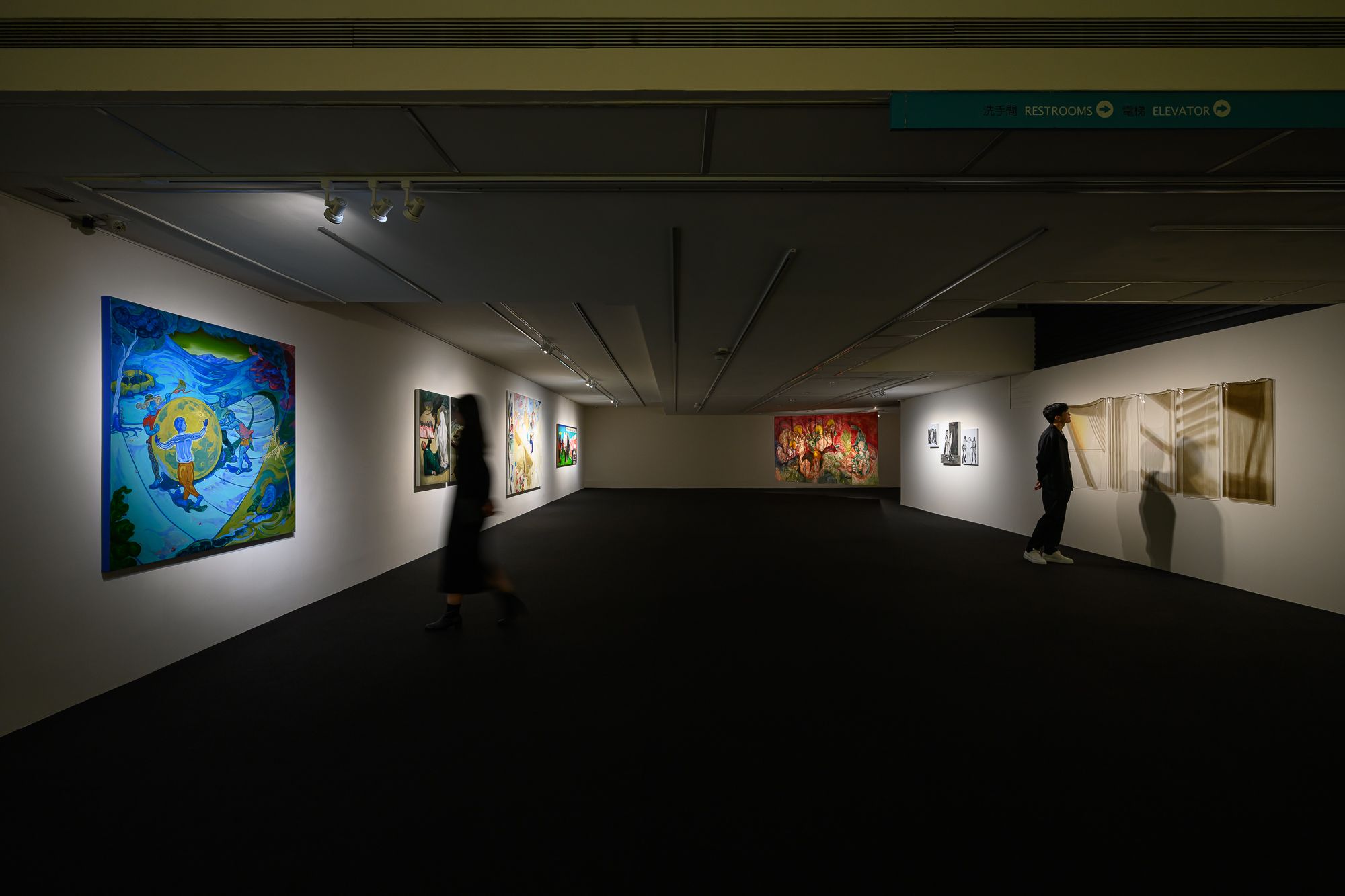
The 19 paintings from the 3rd CTBC Painting Prize are on view at the Kuandu Museum of Fine Arts through June 14. (Photo courtesy of CTBC Foundation for Arts and Culture)
In How to See: Looking, Talking, and Thinking about Art, David Salle states, "What constitutes a picture? Is every painting a picture, or do only certain ones qualify? That depends on whether the painting is powerful enough to evoke a wondrous feeling about the visual world; moreover, it depends on whether the compositional arrangement is in place to precisely present the depicted subject—that is to say, whether the image source, the rectangular frame, and the way paint rests still on the canvas are tightly linked and interdependent."
Looking closely at Lu Guan-Hong’s works, who excels at decontextualizing and re-collaging diverse images, one often cannot help but chuckle: monkeys, Homo sapiens, and police detectives meet solemnly around a table, yet what lies upon it is merely a blueprint for making a sandwich. From a corner pops up a pseudo-internet meme—a semi-realistic yet increasingly scribbly, half-finished horse; inside a claw machine sits a young boy reminiscent of The Grudge (who is actually putting on a facial mask). These pieced-together narratives stem from news, memes, popular culture, or daily observations. In an interview, Lu admitted: “I don't particularly want to address anything specific; I simply wish to highlight an ambiguous, blurred narrative scenario amidst multiple contexts through such image arrangement.”

Lu Guan-Hong, From Cave to the Meeting Table, 2025. Oil on canvas, 116.5 × 91 cm. (Photo courtesy of Lu Guan-Hong)
One cannot help but suspect whether his "nothing specific" is a deliberate posture, for the composition is painstakingly serious. The characters and scenes under Lu’s brush seem traceably authentic to their original sources, which, when thrown together, ought to turn into a Super Smash Bros. Yet, he orchestrates characters and arranges the gradation of light, distance, and hierarchy to his utmost ability, like a meticulously directed theater perpetually ready to stage an absurdist play.
In his honorable mention work, Apocalypse Now: Writing, Empowerment, Spirit-Listening, and Walking Words, the artist states in his statement that he "wished to present a contemporary world — decoupled from the divine, eager to disenchant, and name things, yet ironically rendered disoriented as a result." "Celebrations and downfalls sit side by side; vengeful ghosts co-exist with greedy living beings. Perhaps they all originate from completely different worlds, and once brought into shared presence, it is my own mind that arbitrarily assigns them a storyline." Just like the blindfolded young girl in the painting, who seems at once extracted from a corner of a 19th-century European spiritualist seance, while the traffic accident behind her recalls occult showdown shows on streaming platforms, where secrets of the unseen are endlessly unveiled. His theater seems to offer an abundance of clues; if viewers trespass into it, hopping wildly across the scenes like entering the film Everything Everywhere All at Once, the bizarre, the tearful, and the joyful are all blended together. How is this not real? Do we not live in an era where memes are closer to reality than truth itself?
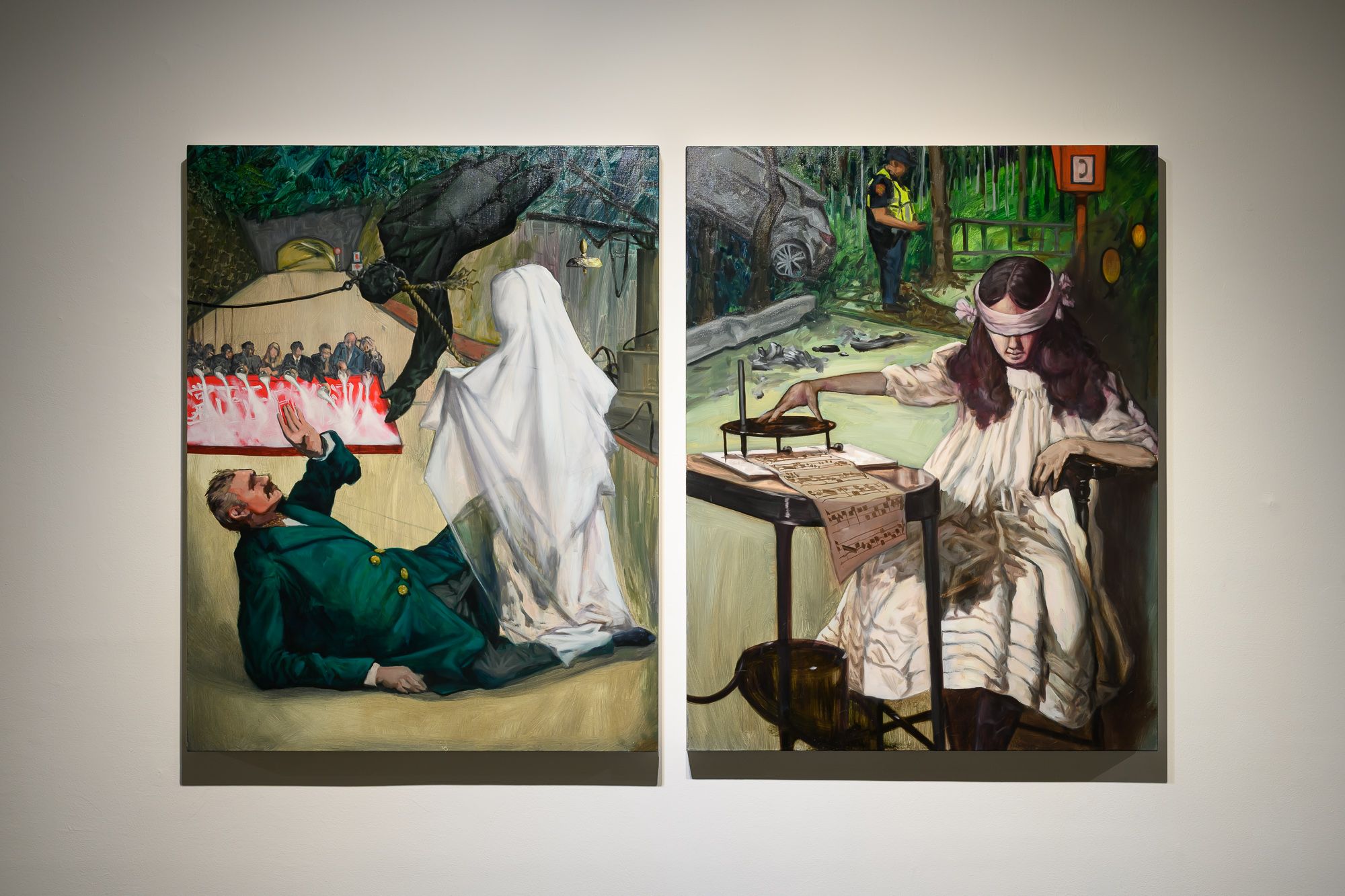
Lu Guan-Hong, Apocalypse Now: Writing, Empowerment, Spirit-Listening, and Walking Words, 2025. Oil on canvas, 116.5 × 182 × 5 cm. (Photo courtesy of CTBC Foundation for Arts and Culture)
We all harbor the urge to draw, especially in places where we shouldn't: on a freshly painted white wall by parents, adding moustaches and outfits to historical figures in textbooks, or graffiti on transformer boxes and roller shutter doors late at night. I sometimes wonder, when Stone Age humans used deep red ochre mixed with a bit of animal fat to paint animals in the caves of Sulawesi, Indonesia, and Lascaux, France, was someone standing beside them throwing up their hands, begging them to please hold themselves back?
The impulse to draw intertwines with the medium itself; what one paints upon and what is readily accessible become entry points for viewing. Lee Fang-Yu’s White Ceramic Tiles, Flower, Gap consists of as many as 72 sets of white tiles, assembled into a massive 14-meter painting. White tiles are the most mundane of materials, shaping the aesthetic of old Taiwanese apartments—complete with chipped corners, harsh 6,000K daylight bulbs, and the indelible water stains at the wall corners. Lee chooses to render her imagery atop them.
Drawing inspiration from the tulips on Type-B construction site fences, she integrates wide, watery, cartoon-style eyes with a hint of classic Japanese manga. Yet, their expressions stare right back at the viewer with a slight sarcasm; that mocking tone, paired with fluorescent yellow, feels particularly infuriating, yet appropriately cute. Outlining repeatedly with charcoal on the tiles, she "paints tulips across units of nine tiles before dismantling and reassembling them." The sense of disorientation—where our brains automatically assemble lines expecting continuity, while physical visual reality tells us otherwise—mirrors the collage aesthetic of Taiwanese everyday life. When you look closely, laser stickers glisten within the gaps, twinkling like nostalgic primary school memories that bring an involuntary smile.
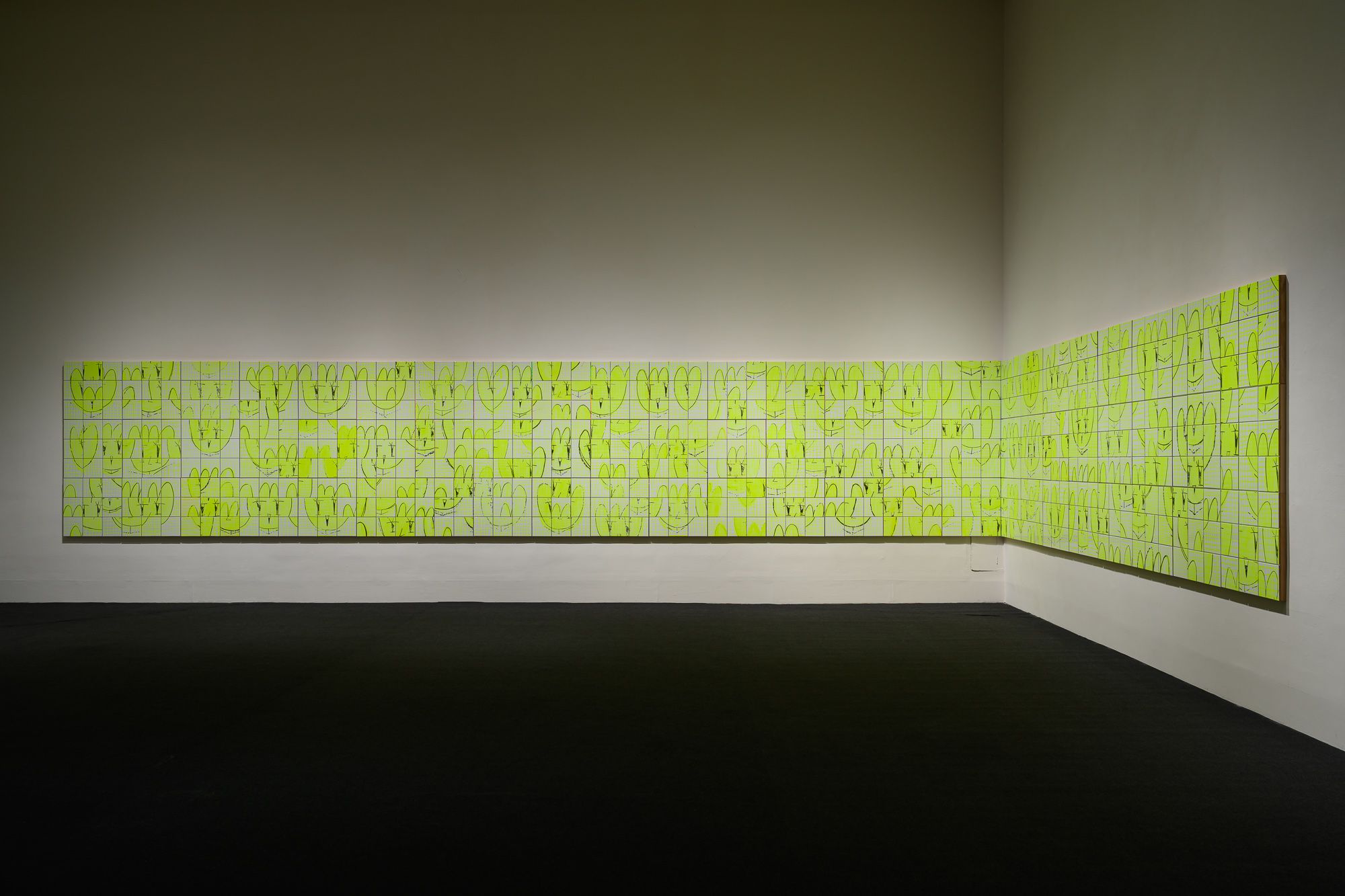
Lee Fang-Yu, White Ceramic Tiles, Flower, Gap, 2025. Acrylic, charcoal, laser stickers, and white ceramic tiles, 184 × 1475.5 × 6 cm. (Photo courtesy of CTBC Foundation for Arts and Culture)
Viewing Lee’s work, an illusion flashed through, as if I were taking a half-hour stroll over and over again—a distance roughly equivalent to walking down from the Kuandu Museum of Fine Arts all the way to Beitou MRT Station. The pace of the walk is slow, with inconvenience to scroll through one's phone; vision moves parallel with the body, eyes rolling and glancing around, occasionally drawn by roadside scenery and trivialities. That viewing experience, much like gazing at White Ceramic Tiles, Flower, Gap, is utterly captivating.
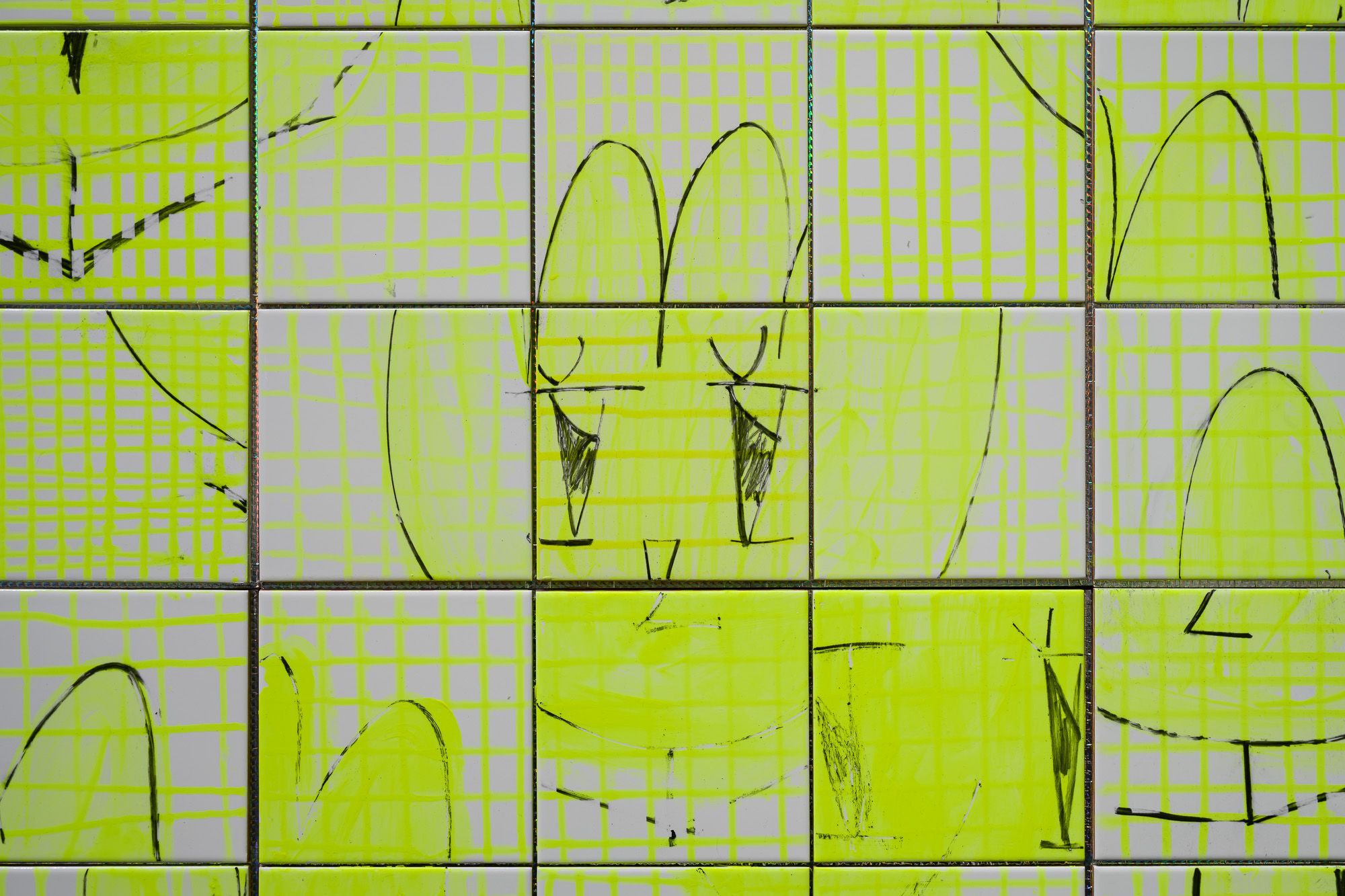
In her first-prize work, White Ceramic Tiles, Flower, Gap, Lee Fang-Yu paints tulips with cartoon facial features and fills the tile gaps with laser stickers. (Photo courtesy of CTBC Foundation for Arts and Culture)
The "CTBC Painting Prize" encompasses not only painting but also the word "contemporary." Yet, if forced to propose a definition of “contemporary painting,” I would tentatively offer that it is not confined to the flat surface or traditional media, but rather blends and weaves together with contemporary discourse, visual imagery, and pop culture. Every word I utter makes me feel self-conscious. I boldly guess that the CTBC Painting Prize does not explicitly seek to define what "contemporary painting" must be; instead, every two years, it gathers everyone to discuss what it could and might be.
Huang Kuan-Chun holds his own unique insight into contemporary painting, even isolating pigment from the painting itself to form what he calls a "painting entity". Huang’s creation does not take place on canvas; instead, he applies acrylic paint directly onto glass platforms, allowing it to dry before peeling it off to shape it, existing as an intermediate state between painting and sculpture. Following this context, Space of Presence and Absence itself possesses no attached surface ; the transparently molded acrylic paint hangs gently in space, upon which the artist subtly paints textures. Thus, as light cascades through, portions of illumination are shielded by the paint, casting fluid shadows onto the wall. Transparency itself becomes a color, and even the shadows become part of the painting —just as Yves Klein famously remarked, "Color is sensitivity in material form." Yet, these overlapping and intersecting layers are only revealed through light and shadow; painting, an object rich in materiality, becomes a state suspended between the reality and illusion.
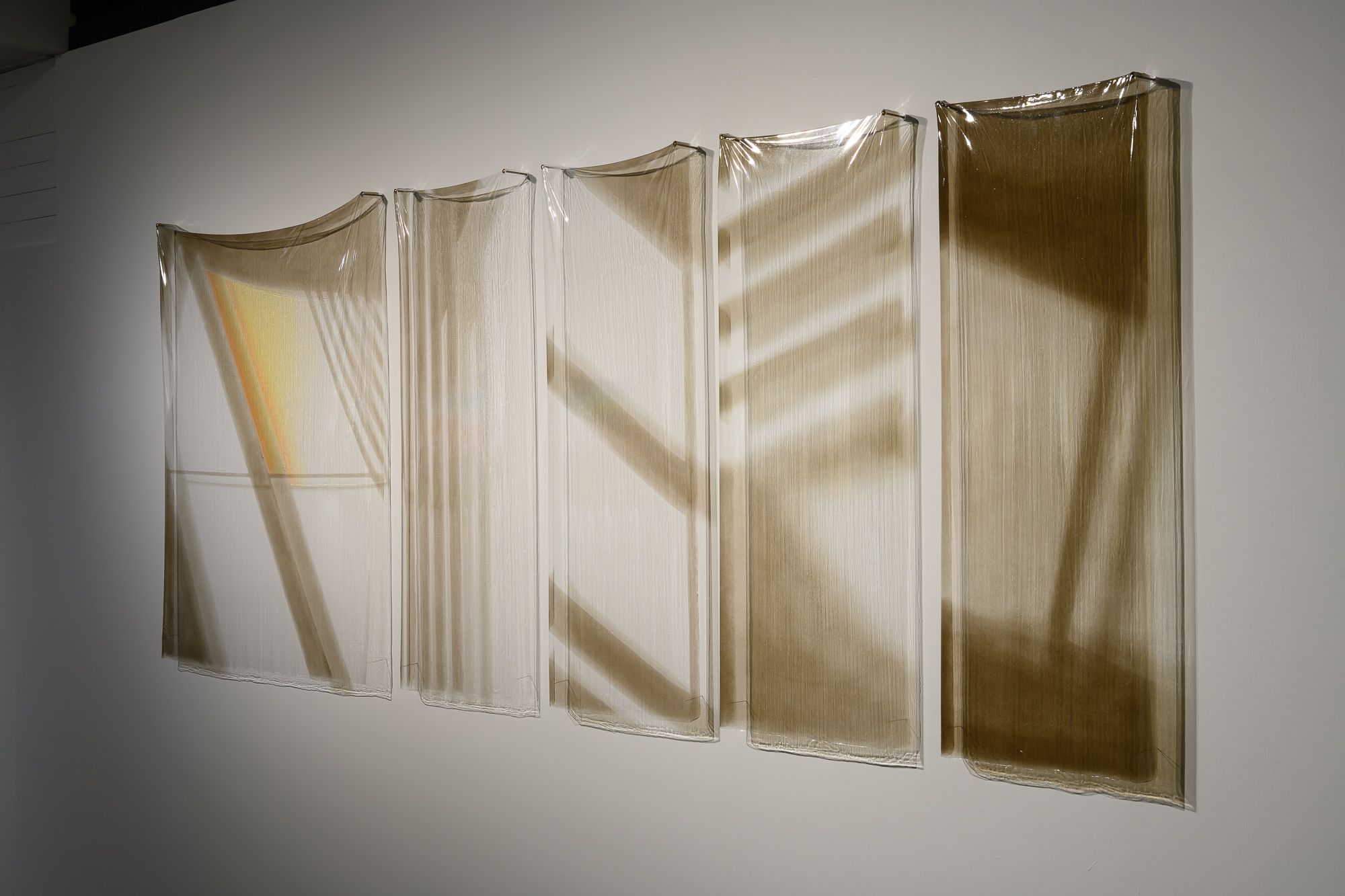
Huang Kuan-Chun, The Space of Presence and Absence, 2025. Acrylic, 108 × 264 × 6 cm. (Photo courtesy of CTBC Foundation for Arts and Culture)
On a side note, acrylic paint is quite sensitive to ambient temperature. In a standard museum air-conditioned environment, it solidifies into a hard texture; yet, if gently cradled by someone with warmer hands, it softens and shifts shape with the heat. That subtle change is deeply moving; such a state of materiality is truly impossible to comprehend without experiencing the physical object in person.
We have long grown accustomed to consuming images on smartphone screens, yet Huang Kuan-Chun’s painting possesses a powerful sense of presence, urging the audience to be there in person to feel that ever-shifting texture. Come to think of it, isn't that true for every work in the exhibition? Without being there in person, how could one ever claim that singular viewing experience, or feel that rush of joy from discovering a tiny detail?
Returning to where I began, none of the questions in my mind had found an answer. Carrying these lingering thoughts down the hill, I realized that the nuances of painting can never truly be replicated on a smartphone screen—they can only be quietly revisited in the solitude of the night.